RSS

Tag Archives: feature film production

PRODUCER SAVED FROM MUSIC BUDGET NIGHTMARE

Ivan Chandler


‘A CINEMATIC RELEASE?’….ALL MEDIA WORLDWIDE IN PERPETUITY?….THIS WILL BE QUITE A FEW THOUSAND!’, SAID THE MUSIC PUBLISHER , SMILING DOWN THE TELEPHONE WITH GLEE! THE MORAL OF THE STORY? GET SOMEONE WHO KNOWS ABOUT MUSIC AND COPYRIGHT!!

Once upon a time in a production office not too far away, a producer was discussing with the director the music they would like for their newfairytale drama.

However, they did not have much money left for music – only about five hundred pounds in fact – as they had spent it all on fancy camera work, costumes, make up, limousines for the ageing fading ex-Hollywood starlet as well as a some special effects that went tragically wrong and had to be re-made by an expensive computer graphics firm who managed to misinterpret what was required.

After hours and hours and hours of editing, the film was close to being finished. The producer admitted he didn’t know much about copyright and had been promising to go along to an Indie Training Fund Music Rights seminar for about three years.

Nevertheless, he knew that some music was out of copyright and always liked Cavalleria Rusticana by deceased Italian composer, Pietro Mascagni. He played some tasty extracts to the director who loved it. So they used it as most of the score of the film.

Then a little bird mentioned that, as the copyright in musical compositions lasts for 70 years after the composer’s death, should they not check that out. It turned out that Mascagni died in 1945 and therefore there was still a further three and half years or so to go before they could use it for free. ‘Oh dear’ said the producer ‘it’s still in copyright!’.

A quick email to the PRS told them to go to the publishers. ‘A cinematic release?….All media worldwide in perpetuity?… This will be quite a few thousand!’, said the publisher probably smiling down the telephone with glee. ‘Well, we could negotiate it – you’ve used a lot of the score but this is not going to be cheap you know’.

The producer said that the recording was out of copyright as it was over 50 years old and, even with the
extension of the copyright term in sound recordings to 70 years, it was an old recording as he had the vinyl to prove it. However, his recording was so scratchy that they had used a CD, a re-released of the original recording. No-one told them that re-mastered recordings with all the scratches, pops and crackles taken out constitute a new copyright recording. A call to the label resulted in a quote for fees on an MFN basis with the publishers. ‘MFN? What’s that?’, said the producer. The label told him that, whatever the publisher wanted, the label needed to charge the same.

Oh, and as the some of the music is over the closing credits, the fee is three times as much. Oh, no! This is a runaway music budget nightmare!

They asked to look at the licence to check the wording and there was a clause about gaining consents from the performers on the recording. On enquiring further, as the recording they had now decided on using (not the original) was first made in England, it turned out that the Musicians’ Union required re-use fees. How many musicians? 70!

Then, as the fees were catapulting higher and higher and whilst the producer and director simultaneously threw their arms up in the ear, a young Production Manager popped her head into their office. She said, ‘I went to one of Ivan Chandler’s Music Copyright Seminars and I know just what to do’. ‘What, what?’, they literally screamed.

You could easily use a library recording for only a few hundred pounds and, if you use lots of extracts from the same recording from the same library, they might even give you a good discount.

The library rates cover the publishing, sound recording and performers’ consents. In fact, you could also use a few special sound effects where appropriate and, in many scenes, by using no music at all, you could even save more!!

The producer, director and production manager clasped hands, jumped round the room and opened a bottle of champagne. Unfortunately, it was taken from the financier’s vintage collection and valued at, guess what, £500.00!

The moral of the story? Get someone who knows about music and copyright!!
Ivan Chandler, Founder & CEO,
Musicalities Ltd,
Music Copyright & Licensing Consultants
www.musicalities.co.uk

Ivan’s Film Credits include: Mouth to Mouth – 2005, My Kingdom – 2001, The Man Who Cried – 2000, 24 Hours in London – 2000, Waking Ned Devine – 1998, The Tango Lesson – 1997, Shooting Fish – 1997, Bring Me The Head of Mavis Davis – 1997.  Television Credits include: Raw – 2012, The Cost of Living – 2005.


Tags: , , , , , , , , , ,

Editor’s Thoughts

… it is almost forgotten that it takes a team of many people with talent to make a motion picture …

I must say, from the feedback I receive, there are so many areas where it’s felt that there is inadequate information and training available. The industry needs young people who are prepared to put in the time and effort to learn the skills and techniques which have been developed and perfected by the professionals who have spent their careers entertaining the audience with their storytelling abilities. 

It’s probably not ‘what have we done wrong?‘ we should be asking but ‘what more do we need to do to put things right?’ in those areas where specific training for the film industry is needed. Quick answer to that is – if you are running a course at whatever level then please enlist the help of industry professionals – individuals, guilds or organizations – to either advise in the initial discussions on course content or attend as guest tutors. 

Perhaps we shouldn’t limit skills training to those who work creatively – production grades coming into the industry may benefit from taking time out to learn about the responsibilities of the crew they going to employ.  An experienced crew member can prevent a great deal of wastage on time and tantrums if they are used efficiently as they will have the ability to read the mood in the meeting or on the floor and change, alter, move and re-invent as often as the director wants with the least amount of fuss. 

Initial decisions on crew, methods and equipment which are based purely on cutting the budget to the bone can eventually become very expensive, as mistakes made due to wrong or ill-advised choices can have a disastrous impact both on the bottom-line and the quality of the finished product.

Keep the feedback coming – I need your thoughts, ideas and comments so that I can make sure that the ‘News’ is covering areas of most interest.

Go to www.network-nine.com and click on the ‘Guilds & Associations’ page to access some of the industry organizations.

 
Leave a comment

Posted by on February 11, 2012 in Feature Film Production


Tags: , , , , , , , , , , , , , , , ,

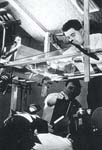
The Special Effects Secrets of Gillie Potter

Gillie Potter 1923 - 2004

Gillie Potter was one of the world’s leading special effects animators and became known as the man who could ‘do the impossible’. His revolutionary work in British commercials advanced the use of special effects in television advertising. He elevated the boring ‘pack shot’ to an art form and invented the device of having live action sequences taking place on a moving product pack.

His commercial work started in the mid 1950s. This work earned him more than 40 international awards, including a Golden Lion at the Cannes Advertising Film Festival and was involved in the production of more than 2,000 ads, including classic commercials for Rolo, Vicks Vapour Rub, Quaker Oats, Nesquick and Shredded Wheat. His special effects work can also be seen in feature films ‘The Last Emperor’, ‘Superman: The Movie’ and ‘Jurassic Park’.

Gillie Potter was a living legend, still working because he loved it, right up until his death in 2004 at the age of 80. He was the magician of advertisements during the early years of commercial television. In those days, trick film work was a novelty and, at the morning coffee breaks across the land, last night’s TV ads would be a hot topic of discussion …. ‘just how did they do that?‘. Indeed, when we look at some of his early show-reels today it is difficult to see exactly how he did it – in fact, they often look digital when digital technology was at least 20 years in the future.

The predominant brief at that time for commercials was that they should contain something which was very different from anything that had ever been seen before. Once this challenge had been faced and some sort of presentation devised, the vital next step was to select the most appropriate method to achieve it. This usually turned out to be the simplest way of doing it and that, in turn, often proved to be the cheapest – or at least the most cost-effective.  The budgets for special effects commercials in those early days were actually quite small compared with those of live action shoots.  

Usually, the main sections of special effects shoots were made ‘in camera’ – sometimes using multiple exposure but more often shooting a free-standing optical illusion that Gillie’s small team had created. The final work might be embellished by optical composites but in-camera methods kept overall control in the hands of the production company. This was often the cheapest and usually the quickest method. They had the further, very positive, advantage of keeping down the number of generations, as film stock was more primitive in those days and generation-free digital copying was not yet even a dream.

Gillie had invented a particular device – the groundbreaking technique of putting a moving picture onto a moving pack. He always tried to obey one very important rule – keeping the product identity – which most often means the product pack itself right there in the shot. How many commercials we see today leave no lasting impression of what they were about!  Gillie’s ingenious idea was to build on this important principle by showing a movie of the product being used on the surfaces of a moving (usually rotating) pack of that very product. This seems easy now, particularly with all the digital systems available but at that time, it was something that had never been seen before in a television commercial. Camera people guessed that he must have used a rotating projector but they were puzzled as to why it didn’t appear in the shot at some point. The crucial item here was a small mirror, which enabled the rotating projector to be positioned below the field of view of the camera.

A cigarette advert which had cigarettes, packets and disembodied titles built up into an increasingly impossible pyramid before the whole structure collapsed, with the cigarettes all landing neatly in their packets. Few viewers ever guessed that the sequence was shot by laying the packet and the cigarettes on a glass table and shooting upwards, from below. The text pieces were to be stop-motion animated onto the film afterwards, so it was vital that the artist’s hand should maintain the correct separation throughout the main shoot. Particularly delightful is a move in which the text of the word ‘tipped’ goes off balance and the letters are meticulously animated to take up a sloping format and then corrected, when the hand goes in to make the line level again.  

This might well have been the very first use of video assist in a commercial shoot, as the cameraman and the director were able to co-ordinate the whole procedure with an improvised form of closed circuit television from a video camera strapped alongside the 35mm film camera.        

This article is published with the kind permission of the Potter family. There is a DVD of this interview, which outlines Gillie’s techniques in detail, particularly useful to course leaders and students who would like to experiment with their own in-camera effects. For more information on purchasing the DVD Network Nine News info@network-nine.com

 
13 Comments

Posted by on February 2, 2012 in Special Effects


Tags: , , , , , , , , , , , , , , ,

Do you want to work in Visual Effects…?


Dayne Cowan

Visual effects, or VFX as it is commonly abbreviated, is an exciting, constantly changing and rapidly growing area of the film industry. These days, it is all pervasive. In many feature films, such as ‘Avatar’, it’s use is completely obvious. In others, such as the ‘The King’s Speech’, it’s success depends on it not being seen at all – but it is there regardless!

This article by Dayne Cowan was published in Network Nine News magazine – for further information or to subscribe go to www.network-nine.com

So what is it like to work in this field, how do you get in to this line of work and what does it take to succeed? Before the advent of university degrees designed for this industry, you could come at it from several angles. When I started, it was common for your fellow artists to have backgrounds in architecture, fine art, computer science or mathematics. I’ve even met people who had degrees in robotics!

This Visual Effects industry demands a curious mix of technical and artistic skills. The left and right brain need to work together, which can be harder to achieve than it sounds. You need a very strong eye for detail and aesthetics, coupled with the ability to cope with some extremely complex software and hardware. The software packages that have so much depth that it isn’t uncommon to go for 16 years without even venturing into certain aspects of it.

Of course, not everyone has a perfect mix of artistic and technical talent but fortunately, there is room for many diverse talents in between. Specialist areas range from colour experts to character designers, to computer programmers, to concept artists and editors.

All these disciplines mean that the experience and entry points are highly varied but the bulk of people in the field share a common experience. Most will work as either 2D artists (compositors), or 3D artists (note: not 3D as in ‘stereo’!) and around 80% of any crew in a VFX facility will fall into these two categories. It’s also worth noting that the distinction between the two is blurring over time, as the software and skills change. Perhaps in the future they will all just be referred to as ‘VFX Artists’.

For everyone in the industry there are some common factors. The job is demanding and can be very high pressure work with tough deadlines. The hours are usually long, typically with a burst of weekend and late night work towards the end of the project. Most of that time is spent behind a computer, where you often lose track of time.. ‘wow, midnight already?’…. so your partner needs to either be very understanding or working with you!

Being a creative process, never expect that your first effort will be the last and never mention that dreaded word ‘final’ The work you produce is going to be poured over many times by many people – sequence leads, vfx supervisors, directors and so on – before it gets approved. Work can often be ‘unapproved’ and worked on further – so be ready for that. It’s hard to let go of that piece that you’ve laboured over for hour after hour but sometimes that’s what you have to do. Shots get changed, work can be omitted from the film. Patience and perseverance are vital! Start by being your own strongest critic. Does it actually look good or right? Would you want that work projected on millions of screens worldwide?

Being a creative industry, not everything that occurs is rational, logical or predictable. It helps to be able to keep a level head and, although we long for it, there is no ideal and it is your ability to solve those inevitable problems with a good natured approach which will set you apart as a skilful and reliable practitioner.

Last of all, be persistent, have a good enthusiastic attitude and keep it fun. After all, no matter what happens, you have to enjoy your work!

Dayne Cowan’s credits include: ‘Battle Los Angeles’, ‘Paul’, ‘Scott Pilgrim vs The World’, ‘Harry Potter and the Half Blood Prince’, ‘The Reader’, ‘10,000 BC’, ‘Harry Potter and the Order of the Phoenix’, ‘Stranger Than Fiction’, ‘The Da Vinci Code’, ‘Mee-Shee: The Water Giant’, ‘Batman Begins’, ‘Tomb Raider: The Cradle of Life’, ‘Below’, ‘Thunderpants’, ‘Blade II’, ‘Dragonfly’, ‘Revelation’, ‘The Beach’, ‘The Avengers’.

 
2 Comments

Posted by on February 2, 2012 in Visual Effects


Tags: , , , , , , , , , , , , , , ,

So, you want to work in the Production Office……?

So, you want to work in the Production Office……?

I miss being a 3rd AD. Every day is new and, because a 3rd doesn’t have to worry about the grander things on set, you can use every moment to watch, listen, learn and implement. I might, at that time, have only been good at making tea and getting the right lunch orders but one has to treat EVERY job as if it is the most important thing in one’s career.

This is from an article written by Terry Bamber in Network Nine News. If you want further information contact me through www.network-nine.com

Sadly, on recent projects, I have had to sack youngsters who have not fully understood the importance of a Production Runner’s job and the dedication and tenacity required. Indeed, everyone’s job on a film is important – right through from the cleaning staff to the Producer – producing a film from script to screen is a joint effort undertaken by every individual in the crew.

The great thing about youth is the experience of turning up each day to be amazed by a wonderfully exciting day. Visiting the set to collect the Camera Sheets from the Camera Clapper/Loader, the tentative approach to the Script Supervisor for her notes to take to the Production Secretary. To make a great cup of tea for the Production Secretary (as she was then called) and to be praised for it used to make my day!

I was working on ‘The Man with the Golden Gun’ at Pinewood and was having a wonderful time as Production Office Runner when the Production Secretary gave me permission to join the 3rd Assistant Director on set to get some floor experience – this brought on a whole new set of challenges!

So, the 2nd Unit was going to shoot on Sunday to help finish the film on time. It had taken me quite a while to understand the complexities of ….‘Tea, medium brown, with a dash of milk and a level teaspoon of sugar’.… it’s almost impossible to make a medium brown cup of tea, with just a dash of milk …. but I digress!

One of the scenes we were filming this day involved Sir Christopher Lee as Scaramanga, the main baddie in the movie.  He is hiding from Bond in the final shootout. I had to cue Mr Lee when he had to step forward from this hiding place.

The first rehearsal commenced and my mind went into overdrive.

Was I supposed to cue Mr Lee as soon as I heard the 1st AD’s voice or leave it a beat and then cue Mr Lee?….    Would Mr Lee see me move my arm to indicate it was his cue for action?….   Should I look at Mr Lee straight in the eye or avert eye contact so as not to distract him?…. 

The first rehearsal started. I could feel perspiration on my forehead and my hands were getting clammy. Suddenly the rehearsal was cut short. Oh Gawd! – had I missed the cue? I stared into the dark of the set and mumbled to Mr Lee that we had stopped ‘I can hear that dear Boy!’ he said. Oops – it was then I remembered the advice my Dad had given me ….‘Keep quiet and people will only think you are an idiot, open your mouth and you remove all possible doubt’….

Communication

One of the worst jobs for 3rd Ads, especially now with so many departments having their own walkie-talkies, is ensuring that batteries are always charged and that you have a check list of which department has chargers, ear pieces and spare batteries. Obviously, you must make sure the Assistant Directors are all catered for but once again, think ahead!! If there is a scene involving action cars then work out how many radios will be required for the drivers to receive their instructions.

As the Second Assistant Director has to make a report at the end of each day noting call times, the time the principal cast were on set, ‘wrapped’ (that is finished work for the day) on set and time they left the studio or locations (this also applies to Background Artistes and Stunts) it’s a great help if the 3rd Assistant is totally thorough in noting these times. It could have a big impact on any overtime that may be incurred by all the elements of the cast.

When the unit breaks for lunch the 3rd AD should find out from the 1st who is in the first setup after lunch and ensure they get their lunch quickly so they can have their makeup/hair and costume checks on time, before coming back to the set. However, sometimes the crew will work a 10 hour straight-through day and then it takes much tighter management to ensure that the cast get enough time to eat. This is when teamwork from all the Assistant Directors is brought to bear. A 1st AD once said that on every shot there is always a perfect position for the 3rd to be to make sure that everything is covered.

A few basic things to remember on set:

ALWAYS LISTEN TO YOUR RADIO – NEVER, NEVER HAVE TO ASK THE 1ST AD TO REPEAT HIM/HERSELF!! THIS IS A CAPITAL OFFENCE!

THINK AHEAD. PREPARATION IS EVERYTHING.

POLITENESS TO EVERYBODY and SMILE, SMILE AND SMILE, NO MATTER WHAT HAPPENS!

NEVER ASSUME ANYTHING – ASSUMPTION IS THE MOTHER OF ALL COCKUPS!

LEARN FROM EVERYONE IN ORDER TO MAKE YOURSELF A BETTER ASSISTANT DIRECTOR.

Terry Bamber’s film & television credits include: ‘World War Z’, ‘Ra.One’, ‘Katherine of Alexandria’, ‘Gulliver’s Travels’, ‘Quantum of Solace’, ‘Casino Royale’, ‘Hitchhiker’s Guide to the Galaxy’, ‘Phantom of the Opera’, ‘Tomb Raider – The Cradle of Life’, ‘Die Another Day’, ‘Lara Croft – Tomb Raider’, ‘102 Dalmatians’, ‘The World is Not Enough’, ‘Tomorrow Never Dies’, ‘The Jungle Book’, ‘Luther’, ‘Poirot’, ‘Dinotopia’, ‘Cadfael’, ‘Young Indiana Jones’, ‘Jeeves & Wooster’, ‘Paradise Club’, ‘Max Headroom’.

 
Leave a comment

Posted by on January 31, 2012 in Production Office


Tags: , , , , , , , , , , , , , , , ,

STORYBOARD MAN!……or how to tell the story in pictures

The following is from an article by Martin Asbury in Network Nine News.  www.network-nine.com

Martin Asbury

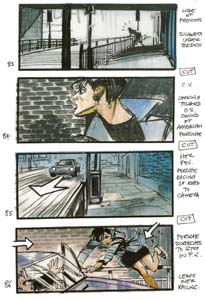
A good storyboard artist has to know, understand and love film. He has to think like a camera and draw pictures as stills of movement. He has to tell you all you need to know about what you will see on screen but leave that little bit out for the imagination and invention.

Cutting my speed to 150 m.p.h. I fly low in a sweeping curve, banking with my crimson cloak streaming out behind me. I swoop in a wide graceful curve over the Film Studios dropping down and landing lithely in the car park on the balls of my feet – like a cat.

The security guard outside the Production Office instantly recognises me. “Thank God you’re here!” he exclaims.

As I stride into the office the Co-ordinator screams with delight. “Thank God you’re here!” she squeals. “The Director – he’s in his office” she smiles wanly. “Go on through.”

Brief, firm knock on the door and I enter. The man at the desk is slumped, his head in his hands. He raises his head, grey faced rheumy blood shot eyes staring at me.

“Storyboardman! Thank God you’re here!” he says. “No problem sir.” I reply. “I’m here to help.”

Quickly I undo my compact drawing tools, sitting opposite him and fixing him with a reassuring yet piercing gaze. I open my sketch book.

“Now what’s the first sequence in the script?”

In the past the making of a film was governed by the script. It was honed and nurtured and worked upon, re-written and re-written. When completed to everyone’s satisfaction it was almost set in concrete. It became the Bible – but these days there appears to be more impediments and pitfalls than ever to this process. Constant writing and re-writing of the script through the prep period can only increase the budget and cause wasted effort. I tell stories in pictures – I have told stories in pictures for all my life. So, if I were asked to direct a film, I would for sure write or draw down what I wanted to do before shooting any sequence – a shot list or stick figures.  It is common sense. Nobody in their right mind would walk onto set with no preparation and no plan.

All those people waiting – all the actors, the producers, the first second third fourth fifth sixth and seventh assistant directors, the lighting cameraman the gaffers, the stage hands, the assistants, the stand-bys – well, you know how it is.. and you are there with nothing in your head..  everyone looking..  it doesn’t bear thinking about!  So, the need for storyboarding becomes obvious.

Over the years they have been used extensively, from ‘Gone with the Wind’ and virtually every film since. On the basis that one picture tells a thousand words, a finished board shows everyone what the director has planned, what they have to do, where they have to be and what they are going to try and achieve.

The Director leans forward conspiratorially. “I need something really dramatic for the opening sequence.”

I tap my pencil. “How about an extreme top shot craning down to a quick track then pan followed by a jib up, jib down low angle Steadicam handheld Skycam sort of locked off shot which favours the star?” I say.

He gasps. “Is that possible?  Can we do that?”  

“We can do anything.” I reply.
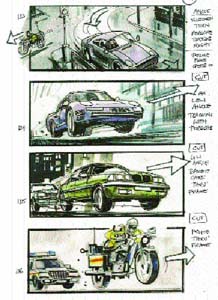
Storyboards are not gospel. They serve as a starting point. They can be, and often are, discarded when events or maybe better options present themselves on the day. They can show what to do but, more importantly, what not to do. A whole 360º set might not be necessary to build. A scene can possibly be cut without detrimental effect to the story or can be revealed as being too costly. They can show whether set or location, when explosions and other special effects might occur or how, for example, to shoot the double of the star in one location whilst at the same time the star himself is shooting on another set elsewhere. They can show how to heighten drama with oh-such-cunning angles and camera moves and, of course, are almost indispensable to the ubiquitous car chase. They save time. They save money.

A side door opens and a large-framed man is framed in the frame. I frame a clever remark but the Director leaps to his feet.

“Problem solved!” He bellows. “Thank God for Storyboardman! What we’re going to do is: an extreme top shot craning down to a quick track then…”  

“Stop!”  The Producer steps forward, face grim. “Slow down! We may not have the money for it.” 

“But..but.. “ The Director gulps. “What about my dream?.. my vision?”
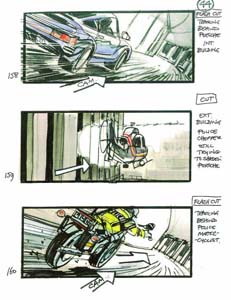
A successful storyboard will reflect the director’s vision, the concept that he has nursed for many months and translate it into usable workable drawings which the whole of the production team will understand. Everyone hopefully singing from the same hymn sheet. To achieve this the artist should try and get inside the director’s head – not to second guess him but to realise his dream for the first time in a visual way.

That sounds grandiose but nevertheless is essentially true. The storyboard is the very first time the script is translated into pictures.

Every director is different and every director wants something different. Some will be most specific about the way they see a sequence down to precise angles, framing and composition. Others will talk you through the scene detailing particular shots they are anxious to include -; a pan here, a track there, low or top shots, the lens to be used, the composition needed -and the storyboard artist will then make the smooth transition and join up the dots.  Others will allow complete carte blanche and the artist can make his own individual pass at the scene, presenting his own take to the director for perusal and criticism. Rarely in such a case does the director accept the offer-up completely and he might not like it at all – but usually much more discussion follows until he is satisfied. He may accept some of it, alter and revise bits or just cherry pick what he wants. All the time though, he is the sole arbiter of what is finally presented to the film’s producers and the rest of the unit.

The Director, leaning against his desk. “We cannot proceed unless we have a plan.”

Storyboardman  “… and I have that plan.”  Quickly I stand up. The Producer’s eyes widen as he takes in my perfectly formed body. 

I am resolute.  “Let me explain.” I say. I outline my extraordinary idea and with every second see him slowly relax, taking it all on board. I finish talking. I am satisfied.

He lowers his gaze. “You really are the one.” He mutters. “Truly  you are wonderful!  I never would have thought of that.”

The storyboard artist is to the director what the concept artist is to the designer. He is a utensil, pure and simple. If he is worth his salt he will support and aid the director in all his endeavours. If successful, his boards can save a huge amount of money and prevent an equal amount of heartache. If nothing else they can offer up a back stop – a safety net if you will – and be the building blocks to gain the most out of any given sequence. They can kick off discussion or decision.

Nowadays with the advent and growth of the use of Previs, the line between the two approaches has become somewhat blurred. Previs are fantastic. They can be totally accurate in that they can demonstrate what any scene will look like from any given camera position, any lens, any lighting source. Clearly a wonderful tool for any director. At the moment they are expensive and take quite a while to produce but I am sure all that, in time, will change. When that day happens maybe storyboards per se will cease to exist – but I hope not. I still feel that the immediacy of drawing to the director on the spot cannot be substituted. A sudden change to shooting requirements can necessitate an instant storyboard. The good artist can block out a whole sequence in a couple of days and provide a cost-effective kick start for the whole creative process.

I quickly draw 1000 frames a day and complete the whole film in two weeks. Needless to say the whole of the production team is overcome and in awe of my dexterity and expertise.

As I present the final sequence to the gathered company the Producer rises to his feet his eyes watery and sad.

“Hey you guys – the Production Company has decided that they are against the whole idea. They are pulling out. We’re not going to make the film after all. See you on the next. Sorry about that….”

A good storyboard artist has to know, understand and love film. He has to think like a camera and draw pictures as stills of movement. He has to tell you all you need to know about what you will see on screen but leave that little bit out for the imagination and invention. An accomplished storyboard is good for what it tells you. If it is drawn well with excitement feeling and vigour then all to the good but it is all about information and communication. For that is why we are all involved in this business. We inform, we communicate, we tell stories and all in pictures.

Martin Asbury’s credit list as a Storyboard Artist includes such films as: ‘Malificent’, ’47 Ronin’, ‘Skyfall’. ‘Snow White & the Huntsman’, ‘The Cold Light of Day’, ‘Captain America’, the ‘Harry Potter’ series, ‘Quantum of Solace’, ‘Wanted’, ‘Casino Royale’, ‘The Da Vinci Code’, ‘Batman Begins’, ‘Die Another Day’, ‘Resident Evil’, ‘Chicken Run’, ‘Entrapment’, ‘Tomb Raider’, ‘Alexander’, ‘Troy’, ‘Michael Collins’, ‘Labyrinth’ and ‘Legend’.

He also took over as the artist for ‘Garth’, the cartoon strip in the Daily Mirror, from 1971 until its final episode in 1997. www.martinasbury.com


Tags: , , , , , , , , , , , , , , , , , , , , , , ,