RSS

Tag Archives: visual effects

From VFX Supervisor to Viral Short Film Director

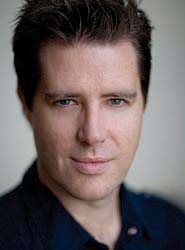
Hasraf Dulull

I knew I wanted to work in film when I saw ‘Batman Begins’ and several years later I ended up working on ‘The Dark Knight’ – one of the proudest moments in my compositing career! – Hasraf Dulull

This article is published in Network Nine News – if you want to subscribe to the magazine go to www.network-nine.com or e-mail info@network-nine.com

I am currently a Freelance Visual Effects Supervisor working at Prime Focus London on several broadcast shows and feature films.

I was recently nominated for two Visual Effects Society awards – BBC One’s ‘Planet Dinosaur’  and Nova’s ‘Life Beyond Earth’ – and I’m currently getting ready to release my own short film ‘Fubar Redux’, an epic motion comic film about a political war set in an alternate reality with cats and dogs!

I have wanted to work in film since the age of twelve when my dad put on a VHS copy of the film ‘Bladerunner’… I was totally blown away by it and  would make mini models of cityscapes in papier maché whilst holding a cylinder to my eye like a camera.

I went to college and did a A-Levels in Technology, Art and Computer Science. (there was no clear route to get into films and my parents were pretty strict about me being too focused on the arts, so I compromised with the computer science part)

At the time of college (early 90s) video games were really a big part of my life and I was able to combine my love for cinema with the interactive world so, whilst I taking my degree, I did work experience for a games company working on cinematics and promotional material.  I was exposed to editing and early visual effects compositing and throughout this time I was always trying out camera moves, doing things you wouldn’t be able to do with a real camera like spin around a bike as it’s racing along the track!

During early 2003, the video games industry started to collapse due to big studios buying out the smaller studios. I was then working in a small studio in the North and really didn’t want to move back down South. So, to keep my self in work and busy I setup my own little CG company and was doing animation for music promos and corporate using high end visual effects.. in the evenings I would then work on my own small projects and did a short trailer called ‘The Chase’. I attended an Autodesk event and there was a ‘show and tell’ session but one of the presenters couldn’t make it. I overheard that they were urgently looking for a presenter to show off work and so I volunteered as I had a DVD of ‘The Chase’ with me anyway!

Nervous as I was, I did the presentation and played the short trailer – and it got a standing ovation! I was asked to play it again and Autodesk asked if they could use it for their marketing campaign. I then got offered a job at one of the largest game developers/publishers in Europe and lead their team in creating action packed cinematics and marketing promos for their driving games.

As the cinematics technology was getting more impressive in the games market, the more I wanted to combine the skills I was using with my love for cinema. I started sending out my showreel to companies dealing with VFX in film. Back in those times games and film were seen as separate industries, whereas today the two blend in really well as both use the same tools, craft and technical knowledge (particles, normal map creations, high poly modelling, motion capture, scanning etc).

I knew I wanted to work in film when I saw ‘Batman Begins’ and I said to my partner I would like to work on the sequel if they make one! Several years later I ended up working on ‘The Dark Knight’ – one of the proudest moments in my compositing career!

I started off doing roto and paint at Moving Picture Company and then ended up moving into compositing, mainly because I had already shown my compositing skills when doing complex rig removals plus my knowledge of Shake.. from there it was upwards over the years at several facilities worldwide as Junior Compositor then Compositor to Lead Compositor and then to Compositing Supervisor, which lead me to becoming a Visual Effects Supervisor.

One of the many things I learned working in different areas of the visual effects industry, from feature film to commercials to music promos and even long form broadcast is – it’s all the same in terms of craft, technical and creative workflows.. the only difference is budget and schedule.  With music videos you have very little time to do very ambitious things and usually work crazy hours, mainly for the love of the music track or directors work… I did loads of music promos at Partizan as well as co-directed some with Little Red Robot in San Fransisco with my good buddy Seth Shevosky who is now Exec Producing my short film ‘Fubar Redux’.

Freelancing at vfx facilities on a project per project basis was the best model for me as opposed to being a full time staff artist because it meant I could have more variety in projects as well as pipelines.  To do this I set up my own company – HaZ-VFX.  I started it up as a way to keep on supporting independent projects such as short films and indies, whilst still working freelance on major feature films. 

These indie projects need VFX done to a tight budget whilst keeping production value high.  Also, working on these indie projects keeps my feet on the ground and allows me to still enjoy and appreciate the film making process which you don’t often get whilst working on those big movies doing VFX in a dark room in a big facility. Working on smaller projects in my spare time also increased my experience as a Visual Effects Supervisor and Producer which got me gigs on high-end broadcast projects like ‘America – The Story of Us’ as well as feature films… so yeah, even though the indies are often low pay or no pay at all… it paid off as it enabled my Visual Effects Supervision career.

Over the years I worked with some amazing people from artists to VFX Supervisors to Creative Directors and Producers at various facilities and studios worldwide and that’s one of the things I love about this industry, everyone knows everyone. So, when it came to me venturing into directing and creating my first short film, I knew it had to be visual effects driven.

I was very heavy into 2.5D compositing, this is basically cheating 3D in a compositing environment as apposed to going into actual 3D CG cameras.  I was one of the early users of The Foundry’s Nuke. So I had a good relationship with them and demo’ing the tool often for them in productions I was involved with.  I approached The Foundry with an idea of creating a short film entirely inside of their powerful compositing tool Nuke and emphasising on the key function of a 3D space inside a compositing tool.  I did some presentation boards and tests in late 2009.

Instantly I was getting support from Matt Pleic and Richard Shaketon, senior product managers at the Foundry. They were key in getting all the support I needed to make this short film. I developed a visual style which would work well with the technology but also served the story telling aspect of the film. This style was – Motion Comics.

Motion comics are basically cut down animated versions of each comic book frame using cut outs from the artwork to create parallax and depth with each shot. Examples can be seen on the Blueray of ‘Inception’ with the ‘Cobal Story’ or on the Blueray of ‘Predators’ – which have several motion comic stories which didn’t get covered in the film and of course, there is the ‘Watchmen’ animated comic DVD.

I wanted to use my VFX compositing experience to take motion comic cinema to another level with extra depth and production values but still keeping the core principles of motion comic story telling. With 2.5D compositing this opens up a load of possibilities to push the motion comic visuals with better animation and more depth and cinematography yet treating each shot like a comic book frame or panel with good pacing, framing and action. I wanted to get away from the usual static like animated action or comic book drawn visuals you get in most of these motion comics. I wanted a photography based visual look to the film.

I then did a presentation at the 2010 International Broadcast Convention (IBC) in Amsterdam as part of a show and tell presentation using ‘Fubar’ as a case study. I cut together an early trailer of the shots I had done and made it look and feel like a Hollywood film by bringing in my good friend Deelan Sital who cuts trailers and promos for feature film marketing – and Luis Almau on the audio and score to help package it all up into a nice glossy presentation.

The trailer was received so well that I had people from the audience coming up to me asking when the film was going to be released – and it started getting press and media attention online with quotes like  ‘Platoon’ meets ‘Animal Farm’. This completely changed my concept of the film from being a technical VFX short, so I started putting a story together and brought on a writer friend of mine – Geof Wolfenden.

One of my favourite books of all time is George Orwell’s ‘Animal Farm’. I loved the idea of using certain animals to depict the chain of command politically. With ‘Fubar’ I chose cats and dogs as they have always been territorial animals but, at the same time, reflect certain characteristics which makes them stand out from one another. Each of them have their strong and weak points yet they both strive for territories. I used that to create the world of ‘Fubar’ and the metaphor of what’s happening around us today with the military, government, war, media and politics.

I released the short film in Sept 2011. Again, its success completely took me by surprise – it was getting reviews and press attention from Vimeo – Short of the Week, VFX forums as well as short film forums.  It was getting huge!

It was really great that it was getting so much exposure but, because of its overwhelming success I felt it only right for me to get the opportunity to finish and release the film in its original final cut version – which wasn’t possible due to financial restrictions.  There was so much that could not be shot and animated which, if included, would have completed the film – especially with some of the characters, plot and story elements that didn’t make it.

I decided to figure out a way to fund the extended version and found Kickstarter.com from a friend of mine, who got his animated short funded that way. I liked the idea of crowdsource funding rather than the traditional route of getting funding from a film council funding board etc, because I wanted to own and keep all the rights to my film and do what I want with it.

The idea is if you like the current short film and want to see the full version as it was originally intended, then please pledge and fund the Extended Redux Edition.  In a way it was kinda like the short was a presale version.

This was also my first foray into crowdsource funding as a producer/director, so I was very excited yet scared. One thing I learned is that you have to put so much work into pushing your crowdsource funding via social media and word of mouth. I managed to raise $6.256 from the pledged goal of $5K.  This was enough for me to pay the editor and audio and use it for marketing and PR and additional VFX support work I needed to make the final cut of the film.

I didn’t need much funding since I was doing all the shot creations and animation myself but there were some elements, like the motion graphics of on screen displays, that needed doing and rendering out as elements for me to put into Nuke, so I had some help with that, as well as the extensive amount of rotoscoping required for the DSLR photography I shot with my partner May Ngo for the miniatures – posed marine models, tanks, helicopters etc and, of course, the cats and dogs.

I was able to gain so much interest from the fans and new audiences of the film to allow me to make the extended redux edition. The power of social media is amazing and is definitely the future for indie film making and distribution!

Following the same VFX support model I used for the first version, this extended edition has visual effects technology support from Peregrine Labs (the developers of the powerful depth of field plugin – Bokeh), Gen- Arts (the award winning Sapphire plugins used for years on big movies) and Shotgun (the asset management tool system used in most of the major facilities worldwide).

In fact having VFX technology support not only allowed me to have access to these tools but also free exposure with their marketing team. For example for 2011 Siggraph ‘Fubar’ was used as a demo to show off Shotgun’s new asset management tool and The Foundry had shots from my film in its Sizzle Reel!

‘Fubar Redux’ is now released, it has been selected for the 2012 Cannes Film Festivals Short Film Corner, as well as other festival eg www.fmx.de and can be viewed on www.fubar-movie.com

Haz’s film credits include: Fubar – 2011, Prince of Persia, Sands of Time – 2010, The Conductor – 2010, Don’t Look Back – 2009, The Dark Knight – 2008, Hellboy II The Golden Army – 2008, Chronicles of Narnia, Prince Caspian – 2008, 10,000 BC – 2008, Tales of the Riverbank – 2008, Elizabeth, The Golden Age – 2007, Spring Heeled Jack – 2006, Chicken Tikka Masala – 2005.   Television: Nova – 2011, Planet Dinosaur – 2011, America, The Story of Us – 2010, Inside the Perfect Predator – 2010, The Colour of Magic – 2008, Superstorm – 2007.   Games: Enemy Territory – 2007, Battalion Wars – 2005.

 
2 Comments

Posted by on April 20, 2012 in Visual Effects


Tags: , , , , , , , , , , , , , , , , , , , , ,

Editor’s Thoughts

… it is almost forgotten that it takes a team of many people with talent to make a motion picture …

I must say, from the feedback I receive, there are so many areas where it’s felt that there is inadequate information and training available. The industry needs young people who are prepared to put in the time and effort to learn the skills and techniques which have been developed and perfected by the professionals who have spent their careers entertaining the audience with their storytelling abilities. 

It’s probably not ‘what have we done wrong?‘ we should be asking but ‘what more do we need to do to put things right?’ in those areas where specific training for the film industry is needed. Quick answer to that is – if you are running a course at whatever level then please enlist the help of industry professionals – individuals, guilds or organizations – to either advise in the initial discussions on course content or attend as guest tutors. 

Perhaps we shouldn’t limit skills training to those who work creatively – production grades coming into the industry may benefit from taking time out to learn about the responsibilities of the crew they going to employ.  An experienced crew member can prevent a great deal of wastage on time and tantrums if they are used efficiently as they will have the ability to read the mood in the meeting or on the floor and change, alter, move and re-invent as often as the director wants with the least amount of fuss. 

Initial decisions on crew, methods and equipment which are based purely on cutting the budget to the bone can eventually become very expensive, as mistakes made due to wrong or ill-advised choices can have a disastrous impact both on the bottom-line and the quality of the finished product.

Keep the feedback coming – I need your thoughts, ideas and comments so that I can make sure that the ‘News’ is covering areas of most interest.

Go to www.network-nine.com and click on the ‘Guilds & Associations’ page to access some of the industry organizations.

 
Leave a comment

Posted by on February 11, 2012 in Feature Film Production


Tags: , , , , , , , , , , , , , , , ,

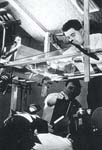
The Special Effects Secrets of Gillie Potter

Gillie Potter 1923 - 2004

Gillie Potter was one of the world’s leading special effects animators and became known as the man who could ‘do the impossible’. His revolutionary work in British commercials advanced the use of special effects in television advertising. He elevated the boring ‘pack shot’ to an art form and invented the device of having live action sequences taking place on a moving product pack.

His commercial work started in the mid 1950s. This work earned him more than 40 international awards, including a Golden Lion at the Cannes Advertising Film Festival and was involved in the production of more than 2,000 ads, including classic commercials for Rolo, Vicks Vapour Rub, Quaker Oats, Nesquick and Shredded Wheat. His special effects work can also be seen in feature films ‘The Last Emperor’, ‘Superman: The Movie’ and ‘Jurassic Park’.

Gillie Potter was a living legend, still working because he loved it, right up until his death in 2004 at the age of 80. He was the magician of advertisements during the early years of commercial television. In those days, trick film work was a novelty and, at the morning coffee breaks across the land, last night’s TV ads would be a hot topic of discussion …. ‘just how did they do that?‘. Indeed, when we look at some of his early show-reels today it is difficult to see exactly how he did it – in fact, they often look digital when digital technology was at least 20 years in the future.

The predominant brief at that time for commercials was that they should contain something which was very different from anything that had ever been seen before. Once this challenge had been faced and some sort of presentation devised, the vital next step was to select the most appropriate method to achieve it. This usually turned out to be the simplest way of doing it and that, in turn, often proved to be the cheapest – or at least the most cost-effective.  The budgets for special effects commercials in those early days were actually quite small compared with those of live action shoots.  

Usually, the main sections of special effects shoots were made ‘in camera’ – sometimes using multiple exposure but more often shooting a free-standing optical illusion that Gillie’s small team had created. The final work might be embellished by optical composites but in-camera methods kept overall control in the hands of the production company. This was often the cheapest and usually the quickest method. They had the further, very positive, advantage of keeping down the number of generations, as film stock was more primitive in those days and generation-free digital copying was not yet even a dream.

Gillie had invented a particular device – the groundbreaking technique of putting a moving picture onto a moving pack. He always tried to obey one very important rule – keeping the product identity – which most often means the product pack itself right there in the shot. How many commercials we see today leave no lasting impression of what they were about!  Gillie’s ingenious idea was to build on this important principle by showing a movie of the product being used on the surfaces of a moving (usually rotating) pack of that very product. This seems easy now, particularly with all the digital systems available but at that time, it was something that had never been seen before in a television commercial. Camera people guessed that he must have used a rotating projector but they were puzzled as to why it didn’t appear in the shot at some point. The crucial item here was a small mirror, which enabled the rotating projector to be positioned below the field of view of the camera.

A cigarette advert which had cigarettes, packets and disembodied titles built up into an increasingly impossible pyramid before the whole structure collapsed, with the cigarettes all landing neatly in their packets. Few viewers ever guessed that the sequence was shot by laying the packet and the cigarettes on a glass table and shooting upwards, from below. The text pieces were to be stop-motion animated onto the film afterwards, so it was vital that the artist’s hand should maintain the correct separation throughout the main shoot. Particularly delightful is a move in which the text of the word ‘tipped’ goes off balance and the letters are meticulously animated to take up a sloping format and then corrected, when the hand goes in to make the line level again.  

This might well have been the very first use of video assist in a commercial shoot, as the cameraman and the director were able to co-ordinate the whole procedure with an improvised form of closed circuit television from a video camera strapped alongside the 35mm film camera.        

This article is published with the kind permission of the Potter family. There is a DVD of this interview, which outlines Gillie’s techniques in detail, particularly useful to course leaders and students who would like to experiment with their own in-camera effects. For more information on purchasing the DVD Network Nine News info@network-nine.com

 
13 Comments

Posted by on February 2, 2012 in Special Effects


Tags: , , , , , , , , , , , , , , ,

Do you want to work in Visual Effects…?


Dayne Cowan

Visual effects, or VFX as it is commonly abbreviated, is an exciting, constantly changing and rapidly growing area of the film industry. These days, it is all pervasive. In many feature films, such as ‘Avatar’, it’s use is completely obvious. In others, such as the ‘The King’s Speech’, it’s success depends on it not being seen at all – but it is there regardless!

This article by Dayne Cowan was published in Network Nine News magazine – for further information or to subscribe go to www.network-nine.com

So what is it like to work in this field, how do you get in to this line of work and what does it take to succeed? Before the advent of university degrees designed for this industry, you could come at it from several angles. When I started, it was common for your fellow artists to have backgrounds in architecture, fine art, computer science or mathematics. I’ve even met people who had degrees in robotics!

This Visual Effects industry demands a curious mix of technical and artistic skills. The left and right brain need to work together, which can be harder to achieve than it sounds. You need a very strong eye for detail and aesthetics, coupled with the ability to cope with some extremely complex software and hardware. The software packages that have so much depth that it isn’t uncommon to go for 16 years without even venturing into certain aspects of it.

Of course, not everyone has a perfect mix of artistic and technical talent but fortunately, there is room for many diverse talents in between. Specialist areas range from colour experts to character designers, to computer programmers, to concept artists and editors.

All these disciplines mean that the experience and entry points are highly varied but the bulk of people in the field share a common experience. Most will work as either 2D artists (compositors), or 3D artists (note: not 3D as in ‘stereo’!) and around 80% of any crew in a VFX facility will fall into these two categories. It’s also worth noting that the distinction between the two is blurring over time, as the software and skills change. Perhaps in the future they will all just be referred to as ‘VFX Artists’.

For everyone in the industry there are some common factors. The job is demanding and can be very high pressure work with tough deadlines. The hours are usually long, typically with a burst of weekend and late night work towards the end of the project. Most of that time is spent behind a computer, where you often lose track of time.. ‘wow, midnight already?’…. so your partner needs to either be very understanding or working with you!

Being a creative process, never expect that your first effort will be the last and never mention that dreaded word ‘final’ The work you produce is going to be poured over many times by many people – sequence leads, vfx supervisors, directors and so on – before it gets approved. Work can often be ‘unapproved’ and worked on further – so be ready for that. It’s hard to let go of that piece that you’ve laboured over for hour after hour but sometimes that’s what you have to do. Shots get changed, work can be omitted from the film. Patience and perseverance are vital! Start by being your own strongest critic. Does it actually look good or right? Would you want that work projected on millions of screens worldwide?

Being a creative industry, not everything that occurs is rational, logical or predictable. It helps to be able to keep a level head and, although we long for it, there is no ideal and it is your ability to solve those inevitable problems with a good natured approach which will set you apart as a skilful and reliable practitioner.

Last of all, be persistent, have a good enthusiastic attitude and keep it fun. After all, no matter what happens, you have to enjoy your work!

Dayne Cowan’s credits include: ‘Battle Los Angeles’, ‘Paul’, ‘Scott Pilgrim vs The World’, ‘Harry Potter and the Half Blood Prince’, ‘The Reader’, ‘10,000 BC’, ‘Harry Potter and the Order of the Phoenix’, ‘Stranger Than Fiction’, ‘The Da Vinci Code’, ‘Mee-Shee: The Water Giant’, ‘Batman Begins’, ‘Tomb Raider: The Cradle of Life’, ‘Below’, ‘Thunderpants’, ‘Blade II’, ‘Dragonfly’, ‘Revelation’, ‘The Beach’, ‘The Avengers’.

 
2 Comments

Posted by on February 2, 2012 in Visual Effects


Tags: , , , , , , , , , , , , , , ,

Do you want to work in Film Production ….. ?

So, you think that you would like to work in film production – why?

Wendy Laybourn - Editor

Is it because you’ve seen all the DVD ‘behind-the-camera’ footage and you fancy yourself in that glamorous world, having cocktails with the stars and walking the red carpet at the première of your latest blockbuster? Or, is it because you have an overwhelming passion to see something you’ve been involved in creating, in whatever capacity, up there on the silver screen? If it’s the former, then forget it and find another career – but, if it’s the latter then take care, you are entering a world where creativity walks hand-in-hand with job uncertainty and life will never be ‘normal’ again!

On any feature film, depending on the budget, there will be hundreds of people employed and, for those aspiring to be director, producer, cameraman, please remember that these are only three out of those couple of hundred people and it takes many years of perfecting your craft to reach these dizzy heights.

However, think carefully about the rest of the film crew – divided into departments and each needing skilled, reliable and committed people to produce a feature film to entertain a global audience.

The time to do this careful thinking is whilst you’re still at school – make no mistake, no matter which career path you choose you will always be best served by getting the highest grades possible – but, if you’re mad enough to think that you might still fancy a job in film production, then you need to do a bit of research – and this is what Network Nine can help you with.

We aim to give you enough information about the whole process of film production from the time the producer selects the script to the screening of the film at the cinema so that you can better understand where your particular talents might be best suited.

I’ll be posting articles from the News at intervals but, if you want to make the most of our information then you need to subscribe to the magazine from the web site www.network-nine.com

 
4 Comments

Posted by on January 17, 2012 in Feature Film Production


Tags: , , , , , , , , , , , , , , , , , , , , , , , , ,