RSS

Tag Archives: cinematography

Film Production Technique …. from a talk given by Alfred Hitchcock in 1948

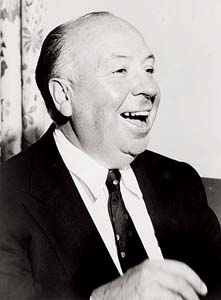
Alfred Hitchcock 1899-1980

The filming of each picture is a problem in itself. The solution to such a problem is an individual thing, not the application of a mass solution to all problems. Film production methods of yesterday may seem out of date today and yet, tomorrow’s problem may be best solved by using yesterday’s methods. The first rule of direction must be flexibility.

Nothing should be permitted to interfere with the story. The making of a picture is nothing but the telling of a story and the story – it goes without saying – must be a good one. I do not try to put on to the screen what is called ‘a slice of life’ because people can get all the slices of life they want out of the cinema. On the other hand, total fantasy is not wanted because people desire to connect themselves with what they see on the screen.

Those are all the restrictions I would place on the story. It must be believable and yet not ordinary. It must be dramatic and yet lifelike.

Having decided upon our story, we must next develop our characters and the plot. When that is done, are we ready to go on to the floor? I maintain we are not because our picture is going to need editing and cutting – and the time for this work is before shooting. The cuts should be made in the script itself, before a camera turns and not in the film after the cameras have stopped turning.

Script Cutting

My objection to the more conventional method of cutting is twofold. First of all, it is wasteful. The tragedy of the actor whose entire part ends on the cutting-room floor is not entirely a personal one. His salary, the sets he acted in and the film on which his acting was recorded all represent expenditure.

More important, if each scene is filmed as a separate entity out of sequence, the director is forced to concentrate on each scene as a scene. There is the a danger that one such scene may be given too great a prominence in direction and acting and its relation to the remaining scenes in the picture will be out of balance, or again, that it may have been given insufficient value and, when the scene becomes part of the whole, the film will be lacking in something.

The ‘extra shots’ made after the regular schedule is completed are necessitated because, in the shooting of scenes, story points were missed. The extra expository shots are generally identified by an audience for what they are – artificial devices to cover what had been overlooked in the preparation of the film.

How can this be avoided? I think it can best be avoided if a shooting script is edited before the shooting starts. In this way, nothing extra is shot and, most important, story points will be made naturally within the action itself.

If we do not edit before we shoot, we may be faced in the cutting room with one of the most difficult of editorial problems – the unexplained lapse of time. The passage of time may be essential to the plot but it may not have been made clear in the sequences that have been shot. There was a time – long since passed – when one would simply have photographed the words ‘one week later’ in transparency and caused them to appear on the screen in mid-air during the second scene.

The lapse of time can easily be indicated by the simple method of shooting one scene as a day scene and the next as a night scene – or one scene with leaves on the trees and the next one with snow on the ground. These are obvious examples but they serve to point to the need for script editing before production commences.

Camera Movement

Ingrid Bergmann and Cary Grant in ‘Notorious’ – 1946

A director tries never to go on the floor without a complete shooting script but, for one reason or another, one often has to start with what is really an incomplete script. The most glaring omission in the conventional script, I believe, is camera movement.  The director may decide on the floor how he is going to film a sequence – but I maintain that the time for such a decision is in the preparation of the script.

Here we encounter once again the fact that the tendency today is to shoot scenes and sequences and not to shoot pictures. The angle from which a scene is to be shot ought to flow logically from the preceding shot and it ought to be so designed that it will fit smoothly into whatever follows it. Actually, if all the shooting is planned and incorporated into the script, one will never think about shooting a scene but merely about shooting a picture of which the scene in question is a part.

Shooting in Sequence

The object of these remarks is to emphasize that I favour shooting pictures in sequence. The film is seen in sequence by an audience and the nearer a director gets to an audience’s point of view, the more easily he will be able to satisfy the audience. The satisfaction of an audience has been deprecated as an aim of picture making and I think that is a very grave mistake. There has been a tendency to sneer at audiences, to regard them as a tasteless mass to whose ignorance phenomenal concessions must be made by producers and directors.

Why is this? One reason is that a director hears comments about his work constantly and these comments come, for the most part, from people associated with the industry. It is laudable to seek the applause and approbation of one’s co-workers but, once one begins making pictures for their satisfaction, it is only a short step to condemning lay audiences for their lack of appreciation of cinema craft.

This is a dangerous point of view. Of course, it is a fine thing to make a picture whose technique excites admiration from people who indeed understand technique – but these are not the people who pay the costs of production!

Audience Groups

A picture-maker need not try to please everyone. It is important to decide at what audience one is aiming and then to keep one’s eye on that target. It is obviously uneconomic to shoot for a small audience and a motion picture costing some hundreds of thousands of pound, which has taken the efforts of perhaps one or two hundred men, cannot direct its appeal towards people with a special knowledge of film-making or to a certain section of the community.

To approach a cinema audience with contempt invites contempt in response. The great playwrights, Barrie and Pinero for example, rendered more than lip service in their respect for their audiences. They wrote every line with a conciousness that it was designed to entertain adult human beings and every line they wrote shows it. By the reasoning of those who maintain that intelligent drama cannot obtain a mass audience, their plays should all have been artistic successes and financial failures – but we know that they were well received, that many of them were terrific hits and we should profit by that knowledge.

Filming Technique 

I turn now to the actual techniques of picture-making. I have a liking, for instance, for a roving camera because I believe, as do many other directors, that a moving picture should really move. I have definite ideas about the use of cuts and fade-outs which, improperly handled, can remind the audience of the unreality of our medium and take them away from the plot – but those are personal prejudices of mine. I do not try to bend the plot to fit technique – I adapt technique to the plot. A particular camera angle may give a cameraman, or even a director, a particularly satisfying effect but, dramatically, is it the best way of telling whatever part of the story it is trying to tell? If not, it should not be used.

The motion picture is not an arena for the display of techniques. An audience is never going to think ‘what magnificent work with the boom!’ or ‘that dolly is very nicely handled!’  The audience is mainly focussed on what the characters on the screen are doing – and it is a director’s job to keep the audience interested in that. Technique which attracts the audience’s attention is poor technique. The mark of a good technique is that it is unnoticed.
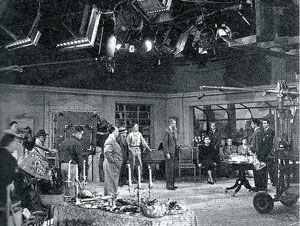
On the set of ‘Rope’ in1948 – the first colour film for Hitchcock

Maintaining Interest

Even within a single picture techniques should vary, although the overall method of handling the story, the style, must remain constant. It is, for instance, obvious that audience concentration is higher at the beginning of a picture than at the end. The act of sitting in one place must eventually induce a certain lassitude. In order that this lassitude should not be translated into boredom or impatience, it is often necessary to accelerate the progress of the story towards the end – particularly of a long picture. This means more action and less dialogue or, if dialogue is essential, speeches ought to be short, a little louder and more forceful that they would be if the same scene were played earlier in the picture.

It is sometimes necessary to encourage artistes to overact!  Of course, it takes a certain amount of tact to induce a good actor to do so and this is another argument in favour of shooting pictures more or less in sequence because, once one has edged an actor into overacting it is, sadly enough, entirely impossible to edge him back again!

Direction is, of course, a matter of decisions. The important thing is that the director should make his decisions when the need for them arises and operate with as few rules as possible.
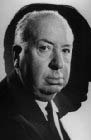
Alfred Hitchcock was born on 13 August 1899, in Leytonstone, London – the son of greengrocers William & Emma Hitchcock. After graduating from the London County Council School of Engineering and Navigation, he became a draftsman and advertising designer with a cable company. During this period, he became intrigued by photography and started working in film production in 1921 in London as a title-card designer for the London branch of what would later become Paramount Pictures.

In 1920, he received a full-time position at the then American-owned Islington Studios and their British successor, Gainsborough Pictures, designing the titles for silent movies. His rise from title designer to film director took five years and, by the end of the 1930’s, Hitchcock had become one of the most famous film-makers in England. Alfred Hitchcock made in excess of eighty films and several television series


Leave a comment

Posted by on November 27, 2012 in How It All Began


Tags: , , , , , , , , , , , , ,

F.A.B! by Gerry Anderson MBE

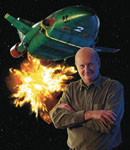
Gerry Anderson (1929 – 2012) with Thunderbird 2

This is an article written for Network Nine News by the legendary Gerry Anderson in 2009. Gerry sadly passed away in 2012 but his story continues with the new Gerry Anderson Legacy Site www.launch.gerryanderson.co.uk

Born in 1929 in London into a poor family, education wasn’t high on the list of priorities and being evacuated during the war didn’t help at all – so, with extreme optimism I decided that I wanted to be an architect and applied to enter a training course! Luckily, the local polytechnic had other building-related courses and I found that I had an aptitude for fibrous plastering and creating decorative pieces which were used for film work. I enjoyed this work enormously for some time but developed an allergy to plaster and had to give up.

I had developed a passion for film work by then and so spent the next few months tramping round the film studios looking for a job.  Eventually, I was taken on by the Colonial Film Unit which was run by the Ministry of Information. Filming was on 35mm and they had a 6-weekly rotation programme so that the trainees got comfortable with all the disciplines – camera, picture editing, sound, direction, projection- and under the guidance of the legendary George Pearson I found that I had a great affinity for editing. George gave me a piece of advice which I’ve always remembered … ‘when you are filming don’t forget to shoot a few feet of a bowl of tulips for cutaways!’ ….

Growing in confidence I applied for and got a job with Gainsborough Studios in Shepherds Bush as 2nd Assistant Editor then worked my way up to 1st Assistant on ‘The Wicked Lady’ in 1945, ‘Caravan’ in 1946 and many more – all for the princely sum of £10 per week! 

Then, as did everyone in those days, in 1947 I was ‘called up’ for National Service with the RAF, where I spent my time as a Radio Telephone Operator.  It was a requirement that, after National Service, everyone was re-instated into their previous job but Gainsborough had closed and I was re-located to Pinewood Studios – then moved to Shepperton as a Sound Editor working on films such as ‘They Who Dare’ in 1954 for the acclaimed Director, Lewis Milestone (‘All Quiet on the Western Front’, ‘Pork Chop Hill’, ‘Ocean’s Eleven’, ‘Mutiny on the Bounty‘) who terrified everyone on set – although I got on with him very well. 

‘Thunderbirds’ character Alan Tracy with Chief Puppeteer Christine Glanville

In 1956 I formed a production company with Arthur Provis – I think that we were one of the first (if not the only) small production company working at that time, calling ourselves AP Films and renting space in an Edwardian mansion in Maidenhead. We had a filing cabinet, a telephone and headed paper, so we were ready for anything!  However, six months went by without any offers and we all had to do extra work to keep ourselves afloat – then the phone rang!!  It was a lady called Roberta Leigh who had 52 scripts for a children’s series called ‘The Adventures of Twizzle’.  We were over the moon, our big chance to show what we were made of – then she dropped the bombshell that it was a puppet show – but, we were hungry for work and even the modest budget and the tight schedule didn’t put us off.

I hated what I had already seen on television as puppet shows and so we decided to add a few ‘film’ techniques to make the sets more realistic with cut-outs in mid and foreground to add depth – also, whenever the puppets were meant to look at each other they always seemed to miss the eyeline as the puppeteers, who by now we had moved up to a high gantry to give more set space, had a very restricted view, so we painted arrows on the puppets heads to make it easier! 

Every episode we made we got a little better. Christine Glanville was the chief puppeteer and made the heads herself from cork dust, glue and methylated spirits – which was infinitely better than the original papier maché as they could be sanded down to a smoother finish. Eventually all the puppets would be made of fibreglass. We noticed that, as the puppets eyes were made of wood, the grain was very noticable when they moved – so we called in William Shakespeare!  No, not the bard but a nice man who made glass eyes – and he produced the first pair of plastic puppet’s eyes for us. As he said, he had never ever been asked for a pair of false eyes before!

Around 250 set-ups were needed for a half-hour episode and the 1/3 life size sets were built on moveable stages to be wheeled in and out very quickly.

‘Thunderbirds are Go!’ – Lady Penelope and Parker on an undercover mission in France!

So successful were we with ‘Twizzle’ and before the series was finished, Roberta Leigh came to us with another new series, ‘Torchy the Battery Boy’.  The budget was increased to nearly double and the team wanted to see how far they could go to improve the look and ‘workability’ of the puppets – finer wires, a spring in the jaw to snap the mouth shut to simulate speaking without the head bouncing up and down as the puppeteers jerked the wires. Eventually mouth movement was controlled by an electro-magnet device – another first – this was when we came up with the name ‘Supermarionation’

We were working on 35mm film with a Mitchell camera and I wanted to see what the TV audience would be viewing as we were working. I bought a lightweight video camera and fixed it to the Mitchell camera we were using so it looked directly down the lens, linking to a monitor and giving us a constant picture.  This ‘Video Assist’ technique was soon adopted by the film industry worldwide.

The next series,  ‘Four Feather Falls’ finished in 1960, and ‘Supercar’ came along in 1962 with the support of Lew Grade and the ITV network. Eventually ‘Supercar’ was broadcast coast-to-coast in the USA and became the top rated children’s programme.

‘Fireball XL5’ followed closely behind in 1963 with ‘Stingray’ in 1965 made in our new home in a large warehouse in the Slough trading estate.  I think that ‘Stingray’was possibly the first puppet series to entertain an adult audience, was shot in colour and had an enormous budget at that time of £20,000 per episode.

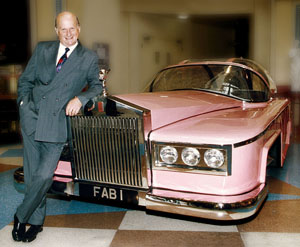
Gerry leaning on FAB 1 – a full-size working model of Lady Penelope’s car in ‘Thunderbirds are Go!’

While ‘Stingray’ was still in production I was writing a new series which eventually would be called ‘Thunderbirds’. Public response when the series was aired was phenomenal! Apparantly the astronaut Alan Shepherd was a fan!  The very futuristic ‘Captain Scarlet and the Mysterons’ came out in 1968 followed by ‘Joe 90’ in 1969.

Shortly after this Lew Grade came apologetically to me and said that, as all the programmes we had produced were being repeated so much on television, we were drowning in our own product so unfortunately, I would have to switch to live action!  What joy – all I’d ever wanted to do was live action!  So ‘UFO’, ‘ Space 1999’ and ‘Space Precinct’ followed

Major developments and change have always been an essential part of the industry. Puppet work has been superceded by CGI and we dipped our toe in the water with ‘Lavender Castle’ and re-made ‘Captain Scarlet’ in 2005 using the latest software – except that I still worked with film people for storyboards and set design to make sure that it had that ‘3-dimensional’ film feel.

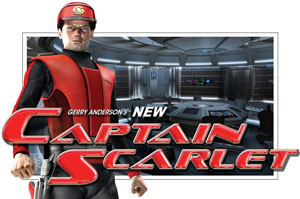
The 2005 CGI version of ‘Captain Scarlet’

I always remember something that Lewis Milestone said to me way back in 1947 when I was working with him.  He said ‘Do you want to be famous?’ … I was slightly taken aback by the question but obviously answered ..‘Yes’‘Never second-guess your audience’ he said ‘make what you want – if they like it you’ll become famous, if they don’t you might as well open a greengrocer’s shop!’  I have lived up to this advice throughout my career!

I really enjoy what I do and can’t imagine retiring – the technology and techniques during my career have changed so much and continue to evolve, so it makes each fresh project an exciting and rewarding challenge.

Ed: Gerry brought much joy and entertainment to several generations of of fans. Hopefully, through re-runs and perhaps through unfinished projects which may be completed in the future, his legacy will continue.

Gerry Anderson’s film & television credits include: New Captain Scarlet – 2005; Lavender Castle – 1999; Space Precinct – 1994; Dick Spanner – 1987; Terrahawks – 1983; Space 1999 – 1975; The Protectors – 1972; UFO – 1970; Doppelganger – 1969; Joe 90 – 1968; Thunderbird Six – 1968; Captain Scarlet and the Mysterons – 1967; Thunderbirds are Go – 1966; Thunderbirds – 1965; Stingray – 1964; Fireball XL5 – 1963; Supercar – 1960; Four Feather Falls – 1959; Torchy the Battery Boy – 1958; The Adventures of Twizzle – 1957

 
1 Comment

Posted by on June 28, 2012 in Animation


Tags: , , , , , , , , , , , , , , , , , , , , , , , , , , , , , ,

A JOURNEY FROM PRODUCING SHORT FILMS TO A MICRO-BUDGET FEATURE by Christine Hartland

I fell into the film industry thanks to my downstairs neighbours asking me if I wanted to produce a short which a friend, Amelia Hann, had written and wanted to direct. At the time I was (and still am) working as a corporate event and video freelance producer so didn’t really think it would be a big jump – how wrong was I?!   (from an article written by Christine Hartland in Network Nine News)

I met Amelia early 2001 and came on board her S16mm short film ‘Big Girl Little Girl’. I knew nothing about working on film itself as I had only ever worked on video, so things like shooting on 24fps or 25fps or what a focus puller did, was a total mystery. Luckily, another producer came on board and her knowledge was invaluable and we made it all happen. In 2004 ‘Big Girl Little Girl’ won a few awards and can now be seen on the BBC film network thanks to Dazzle (the short film distributor).

I learned an awful lot on that project and caught the bug: I wanted to carry on producing short films with the view of one day maybe producing a feature. The film industry became more accessible and doors were starting to open, especially after the festival run.

The next short film I produced was the 35mm ‘Sick’ by Mike Rymer, which tackled the subject of depression.  Not an easy sell but the support of the Samaritans right from the beginning was invaluable. In 2004, we submitted the project to the Wandsworth Film London scheme and were awarded some production money. A year later in August 2005 with £10,000 in the bank, we shot ‘Sick’ on 35mm. Like Mike, I was keen to shoot it on film as opposed to video. Film does look incredible and, thanks to the support from Kodak, Panavision and Deluxe, we were able to do that. It suited the content of the film and we knew that we wanted to show it eventually in cinemas, which has just happened as the film was shown recently at the Odeon Cinema as part of Epsom Mental Health week. 

Just like on ‘Big Girl Little Girl’ it took us a year or so before we had a fine cut during which time we managed to raise additional fund to cover post-production costs (to include neg cutting, grading, Dolby 5.1 sound mixing at Goldcrest) thanks to the South London and Maudsley NHS Fund which remit matched ours: to raise awareness of depression.

In 2007 the film was finally sent to festivals. Mike managed the whole festival strategy over the course of two years (the ‘A’ list festivals in the first year and subsequent festivals in the second year).  A lot of hard work but so necessary in order to get the film out there to be noticed. Once again we managed to get financial support, this time from Screen South.

Over that time I also helped on two other shorts ‘Wooden Soul’ by Rehana Rose Khan (distributed by Shorts International – 2006) and ‘4 Conversations About Love’ by Jessica Townsend and producer Maria Goyal (distributed by New World Films – 2006). Both were shot on HD, which was the new format at the time, so that was quite exciting. I was also starting to read feature film scripts.

In August 2008, an editor friend suggested that I get in touch with David Holroyd who was looking for a producer to make his micro-budget film, a political thriller called ‘WMD’, which had been short listed (but not selected) in the Film London Microwave Scheme. I really liked the script and the concept. David was keen to shoot on CCTV and surveillance cameras, which was quite exciting, different and innovative – but at the same time very risky.

Very quickly I approached some investors I had met at the Cannes Film Festival a couple of years before. We signed the contract in November and the filming started on 21st January 2008 for about 30 days spread until early March. The filming included shoots in Berlin, Rome and Washington. Post-production started as we were shooting with editor Celia Haining at Clear Cut Pictures, which were extremely supportive. My aim was to finish the film by May 2008 so I could take it to the Cannes Film Festival market with a view of finding a sales agent. Risky strategy as sales agents do not go to markets to acquire more films but sell the ones they already have – but I felt as a first time producer that it was my only shot.

In May 2008 we showed the film at the market and had a few sales agents interested. Success – the strategy worked! Back in London, Independent Film Company (‘Adulthood’, ‘Mr Nice’ amongst many) took the film on.

We wanted to get the film out very quickly and decided to follow a reverse distribution strategy, which in itself was very risky as no one had done it before: we launched it at the Brighton Film Festival and on the digital platform Dailymotion for 48 hours in December 2008. Very quickly we had so many hits, three times more than their most watched film, that Dailymotion asked to expand the screening to many other territories over those 48 hours so we knew there was solid interest in the film.

In 2009 we sent the film to a few festivals including East End Film Festival in London, where it was nominated as Best Debut UK Feature. We also sent it to people such as  the Vanity Fair Editor, Graydon Carter, Clare Short (then an MP) and John Pilger for an endorsement. They all liked it! In October 2009, we had a simultaneous UK theatrical & iTunes release which lead to 3 star reviews from both the Guardian and Channel 4, describing the film as ‘gripping’. In 2010 ‘WMD’ is still going and we are continuing to look at opportunities to get it out there – it never stops it seems! The latest screening to date is on Scandinavian Television on the 1st December 2010. 

The speed at which ‘WMD’ happened was incredible especially compared to the short films I had previously worked on. In less than one year we had a feature length film in our hands and a sales agent on board. It seems that when you have no money, projects can either take a very long time, as people work in their down time alongside their paid work, or go very fast as people block book some time off for the project and all has to fit within that time. The latter is how we managed to make ‘WMD’ – there was no other way possible at the time.

However, one of my biggest learning curves was the phase once the film was completed: it was the beginning of a very long process and journey.  The work, especially for a small independent production, can be slow and painful as usually there is not much industry support and/or barely any budget for advertising and PR, which is key to get your film out there to the world. Whether it is a short or a feature it takes a lot of time, energy and perseverance to get the film out there as well as a little bit of money despite the fact that nowadays a lot of things can be done for free eg. social networks etc.

In October 2010, ‘Sick’ was launched at the BFI – that is five years after we shot it – and in 2011 there may well be some more news about it so does it ever stop? It does not seem to and that is a short film! Therefore as a producer, a good relationship with the film director is key as embarking on a film is not a short but a rather long and adventurous journey.

Unfortunately nowadays, producing a debut feature often means that it will be on a micro-budget level (ie under £100,000 and often even under £50,000). What is key is a good script, a good director and cast, and, a very dedicated crew with a lot of support from family, friends, colleagues. A bit of luck and good timing are also very important but harder to factor in!

Personally, apart from still pushing ‘WMD’, my next step is raising money for the next features I am working on using whatever support I can get. For example, for the feature project ‘Nitrate’ by Guy Ducker and Gavin Boyter, we have had a bit of interest after the Trailermade Competition in which it was one of three winners. To be able to show a pre-feature trailer has been very beneficial and, as an independent producer, the main aim is to make sure the project is out there and get noticed. With what I have already learned, I am able to help other debut feature directors and producers with their first micro-budget features. Currently filming is ‘Life Just Is’ by Alex Barrett which is being promoted on YouTube,  both during and post shoot so feel free to check  it out. Again the aim is to raise as much awareness of the project both in terms of building an audience as well as being noticed by the film industry. Let’s see how it goes!

My final thought I would like to share with you: I believe that thinking outside the box and using any means possible such as script (or any other) competitions, seminars, networking events, new technologies, partnerships, charity support, festivals, film markets, endorsements etc can only help get your project noticed by both its audience (very important to know who the film audience is) and the film industry (key for future projects). Good luck!

 
2 Comments

Posted by on June 6, 2012 in Feature Film Production


Tags: , , , , , , , , , , , ,

Motion Picture Photography

Motion Picture Photography, from a lecture in 1949 by Freddie Young OBE BSC

You have to consider the relation of the cameraman to the director. Some directors are technically wise and help the cameraman sympathetically with his difficulties by arranging action so that it was possible to light speedily, or possibly arranging for a cut in order to avoid an otherwise complicated lighting problem. Nevertheless, the director must have the final decision, since the ultimate responsibility for success or failure of the film rested with him and all the technicians – even the stars – must bow to his judgement.

An experienced lighting cameraman will have learned ways of saving time and will not be experimenting in the same way as a beginner – but he must be careful to avoid turning out stereotyped photography, without artistry or meaning.

Not every picture gives the cameraman the opportunity to show artistic ability. Often he is put on his mettle to demonstrate his speed of working and yet is still required to produce a photographically acceptable picture.

Natural Lighting

Some cameramen strive for naturalistic lighting, the light appearing always to come from a correct source. Others seem to ignore this requirement and allow the light to fall from any direction, providing only that the general effect is satisfactory. I prefer natural lighting so that, when shots are edited, there is a feeling of smoothness and correctness over the entire sequence.

However, this requirement introduces a number of problems. A star often looks better with the key light directly in front and not at all satisfactory with cross-lighting – compromises are often necessary. Front key lighting is flattering to most faces but it can be uninteresting to see an entire picture with the principal characters lit from the direct front, regardless of where the scene is located or the time of day. Some producers maintain that it is necessary only that the stars should look attractive but good lighting is noticed, even if only subconsciously, by the audience.

Questions of mood and atmosphere must not be ignored. Such factors help to make a scene convincing and to maintain a sense of reality with which no film can be considered an artistic success.

Black and White vs Colour

In lighting for black-and-white photography one seeks to obtain a stereoscopic effect by a separation of the planes of the subject, so giving an impression of depth and roundness. A frequent method of producing this illusion is by the use of back-lighting. However, it is not always correct to have light emanating from the back of the set and the use of back-lighting has, in the past, been overdone.

There is an infinite variety of methods of securing contrast in light and shade. A patch of light on a wall will throw into sharp relief a dark mass of furniture standing in front of it. A cunningly placed shadow makes the perfect background for a light object. The cooperation of the art director is valuable in the careful selection of colours and in avoiding placing dark objects one in front of another.

Colour photography is, in some respects, less exacting as colours will separate from each other naturally – one would obviously avoid having a navy-blue dress in front of navy-blue drapes. All such factors will be appreciated by a trained artist and it would be an excellent thing if every cameraman had some art training in order that he might appreciate the laws of perspective and of light and shade.

Light Sources

Just as it is necessary for an artist to have a variety of paints and brushes of all sizes, so must a cameraman have lights of all shapes and sizes. Powerful lights for the broad strokes and smaller lights for the fine detail. Every light has to be controlled and spill or leak light must be kept from illuminating the shadows. All the units must have their barndoors, diffusers or ‘goboes’

Lighting in a low key, such as moonlight or firelight, calls for great skill and judgement. It is easy to under-expose and so lose contrasts. It is desirable to have somewhere in the picture one highlighted point – moonlight, a street lamp, firelight or even a streak of light under a door. Reflectors must be used to give a soft radiance without any definite light source – but as a general rule there should be one highlight in the picture and one area of deep black.

The Light Meter

A light meter is used to obtain a consistent density throughout the film. The negative is developed by sensitometric control and only a small latitude is allowable for incorrect exposure. If the laboratory were to be able to work to a constant gamma and obtain a fixed density throughout the entire negative, the cameraman is compelled to use a light meter.

It would be foolish to try to judge by eye a quantity that could be indisputably measured by means of a light meter. On the other hand, the cameraman must never allow the meter to become his master but must use it as a servant to assist him technically to accomplish the final artistic achievement.

For interiors I prefer to work at low light levels and a wide lens aperture, which more closely approximates the characteristics of the human eye. This also lends reality to practical lights used on the set, such as candlelight, oil lamps or electric lamps of low wattage which, if a high key lighting were used, would be unnaturally dimmed.

Problems of Movement

In cinematography, an entirely different set of problems is presented from those of still photography. The motion picture cameraman has to allow for the movement of his characters. If, for instance, an actor moves towards the key light, the brilliance might increase from perhaps 100 footcandles and serious over-exposure would result. Dimmers must be provided to control the intensity of light throughout the scene. The dimmer controls must be checked by the cameraman with the aid of a light meter.

Shooting in the artificial rain on ‘So Well Remembered’ – 1947 in Denham Studios starring Sir John Mills and directed by Edward Dymytryk.

Examples of quite different looks were screened for the audience. In ‘Goodbye Mr Chips’ made in 1938, there is a mellow atmosphere associated with a traditional English school. In contrast, the ’49th Parallel’ made in 1941, has an atmosphere almost documentary in style. It was photographed during the early stages of the War, most of the exteriors being taken in Canada – these exteriors set the key which had to be matched in the shots taken in a British studio.  The 1947 film ‘So Well Remembered’ was set in a town in the North of England and, to create the atmosphere of squalor, artificial rain was freely used.


Some of the comments from the Q&A session following the lecture:

Q: What do you think of the use of the t-scale compared with the old f-value?

A: f-calibration is not definite enough and great errors have been found between different lenses whose f value marking is the same. The new method of calibrating lenses by transmission values will, I’m sure, be welcomed by all cameramen. Difference in aperture can still be due to play in the iris of the diaphragm.

Q: Can you expound on a simple formula for high-key and low-key lighting in footcandles?

A: If the director wants great depth I might set my lens stop at f5.6 and use 300 footcandles, whereas in the low-key set I would work at f2.8 with 80 footcandles, depending on the colour of the set – that’s a most important factor. For a high key of light, the ordinary fair face with normal makeup would demand 100 footcandles at f3. If you wanted the face in a dingy light you could work down to 50 or 60 footcandles at f3. 

Freddie Young (1902-1998)

Building a set at the Shepherd’s Bush Studios. At the Debrie camera are Freddie Young (left) and St. Aubyn Brown


Freddie Young entered the film industry in the silent era and, in 1917 he started working at Shepherd’s Bush, gaining his first credit as assistant cameraman on ‘Rob Roy’ directed by  W.P. Kellino in 1922.  By 1928 he was chief cameraman and, in 1929 Herbert Wilcox, largely ignorant of the technical aspects of film craft, placed Freddie under contract to his company British and Dominions, leading to his first solo credit in 1930. Any visual flair in Wilcox’s films of the 1930’s was allegedly due to Young’s inventiveness and technical skill. his first use of Technicolor was in one reel of Wilcox’s ‘Victoria the Great’ in 1937.

He worked from 1922 to 1985 on more than 130 feature films and several television productions. His many awards include an OBE in 1970 and Oscars for ‘Lawrence of Arabia’ – 1963, ‘Doctor Zhivago’ – 1966 and ‘Ryan’s Daughter’ – 1971, as well as the ASC International Award, a BAFTA Academy Fellowship, four BSC Best Cinematography Awards and a Golden Globe in 1963. 

He invented  the process of pre-exposing colour film (pre-fogging) to mute the colours, giving the ability to alter the look of colour photography to suit the subject. This was first used on ‘The Deadly Affair’ directed by Sydney Lumet in 1966 and was the first British cinematographer to film in Cinemascope.

 
5 Comments

Posted by on May 3, 2012 in How It All Began


Tags: , , , , , , , , , , , , , , , , , , , , , , , , , , , , , , , ,

From VFX Supervisor to Viral Short Film Director

Hasraf Dulull

I knew I wanted to work in film when I saw ‘Batman Begins’ and several years later I ended up working on ‘The Dark Knight’ – one of the proudest moments in my compositing career! – Hasraf Dulull

This article is published in Network Nine News – if you want to subscribe to the magazine go to www.network-nine.com or e-mail info@network-nine.com

I am currently a Freelance Visual Effects Supervisor working at Prime Focus London on several broadcast shows and feature films.

I was recently nominated for two Visual Effects Society awards – BBC One’s ‘Planet Dinosaur’  and Nova’s ‘Life Beyond Earth’ – and I’m currently getting ready to release my own short film ‘Fubar Redux’, an epic motion comic film about a political war set in an alternate reality with cats and dogs!

I have wanted to work in film since the age of twelve when my dad put on a VHS copy of the film ‘Bladerunner’… I was totally blown away by it and  would make mini models of cityscapes in papier maché whilst holding a cylinder to my eye like a camera.

I went to college and did a A-Levels in Technology, Art and Computer Science. (there was no clear route to get into films and my parents were pretty strict about me being too focused on the arts, so I compromised with the computer science part)

At the time of college (early 90s) video games were really a big part of my life and I was able to combine my love for cinema with the interactive world so, whilst I taking my degree, I did work experience for a games company working on cinematics and promotional material.  I was exposed to editing and early visual effects compositing and throughout this time I was always trying out camera moves, doing things you wouldn’t be able to do with a real camera like spin around a bike as it’s racing along the track!

During early 2003, the video games industry started to collapse due to big studios buying out the smaller studios. I was then working in a small studio in the North and really didn’t want to move back down South. So, to keep my self in work and busy I setup my own little CG company and was doing animation for music promos and corporate using high end visual effects.. in the evenings I would then work on my own small projects and did a short trailer called ‘The Chase’. I attended an Autodesk event and there was a ‘show and tell’ session but one of the presenters couldn’t make it. I overheard that they were urgently looking for a presenter to show off work and so I volunteered as I had a DVD of ‘The Chase’ with me anyway!

Nervous as I was, I did the presentation and played the short trailer – and it got a standing ovation! I was asked to play it again and Autodesk asked if they could use it for their marketing campaign. I then got offered a job at one of the largest game developers/publishers in Europe and lead their team in creating action packed cinematics and marketing promos for their driving games.

As the cinematics technology was getting more impressive in the games market, the more I wanted to combine the skills I was using with my love for cinema. I started sending out my showreel to companies dealing with VFX in film. Back in those times games and film were seen as separate industries, whereas today the two blend in really well as both use the same tools, craft and technical knowledge (particles, normal map creations, high poly modelling, motion capture, scanning etc).

I knew I wanted to work in film when I saw ‘Batman Begins’ and I said to my partner I would like to work on the sequel if they make one! Several years later I ended up working on ‘The Dark Knight’ – one of the proudest moments in my compositing career!

I started off doing roto and paint at Moving Picture Company and then ended up moving into compositing, mainly because I had already shown my compositing skills when doing complex rig removals plus my knowledge of Shake.. from there it was upwards over the years at several facilities worldwide as Junior Compositor then Compositor to Lead Compositor and then to Compositing Supervisor, which lead me to becoming a Visual Effects Supervisor.

One of the many things I learned working in different areas of the visual effects industry, from feature film to commercials to music promos and even long form broadcast is – it’s all the same in terms of craft, technical and creative workflows.. the only difference is budget and schedule.  With music videos you have very little time to do very ambitious things and usually work crazy hours, mainly for the love of the music track or directors work… I did loads of music promos at Partizan as well as co-directed some with Little Red Robot in San Fransisco with my good buddy Seth Shevosky who is now Exec Producing my short film ‘Fubar Redux’.

Freelancing at vfx facilities on a project per project basis was the best model for me as opposed to being a full time staff artist because it meant I could have more variety in projects as well as pipelines.  To do this I set up my own company – HaZ-VFX.  I started it up as a way to keep on supporting independent projects such as short films and indies, whilst still working freelance on major feature films. 

These indie projects need VFX done to a tight budget whilst keeping production value high.  Also, working on these indie projects keeps my feet on the ground and allows me to still enjoy and appreciate the film making process which you don’t often get whilst working on those big movies doing VFX in a dark room in a big facility. Working on smaller projects in my spare time also increased my experience as a Visual Effects Supervisor and Producer which got me gigs on high-end broadcast projects like ‘America – The Story of Us’ as well as feature films… so yeah, even though the indies are often low pay or no pay at all… it paid off as it enabled my Visual Effects Supervision career.

Over the years I worked with some amazing people from artists to VFX Supervisors to Creative Directors and Producers at various facilities and studios worldwide and that’s one of the things I love about this industry, everyone knows everyone. So, when it came to me venturing into directing and creating my first short film, I knew it had to be visual effects driven.

I was very heavy into 2.5D compositing, this is basically cheating 3D in a compositing environment as apposed to going into actual 3D CG cameras.  I was one of the early users of The Foundry’s Nuke. So I had a good relationship with them and demo’ing the tool often for them in productions I was involved with.  I approached The Foundry with an idea of creating a short film entirely inside of their powerful compositing tool Nuke and emphasising on the key function of a 3D space inside a compositing tool.  I did some presentation boards and tests in late 2009.

Instantly I was getting support from Matt Pleic and Richard Shaketon, senior product managers at the Foundry. They were key in getting all the support I needed to make this short film. I developed a visual style which would work well with the technology but also served the story telling aspect of the film. This style was – Motion Comics.

Motion comics are basically cut down animated versions of each comic book frame using cut outs from the artwork to create parallax and depth with each shot. Examples can be seen on the Blueray of ‘Inception’ with the ‘Cobal Story’ or on the Blueray of ‘Predators’ – which have several motion comic stories which didn’t get covered in the film and of course, there is the ‘Watchmen’ animated comic DVD.

I wanted to use my VFX compositing experience to take motion comic cinema to another level with extra depth and production values but still keeping the core principles of motion comic story telling. With 2.5D compositing this opens up a load of possibilities to push the motion comic visuals with better animation and more depth and cinematography yet treating each shot like a comic book frame or panel with good pacing, framing and action. I wanted to get away from the usual static like animated action or comic book drawn visuals you get in most of these motion comics. I wanted a photography based visual look to the film.

I then did a presentation at the 2010 International Broadcast Convention (IBC) in Amsterdam as part of a show and tell presentation using ‘Fubar’ as a case study. I cut together an early trailer of the shots I had done and made it look and feel like a Hollywood film by bringing in my good friend Deelan Sital who cuts trailers and promos for feature film marketing – and Luis Almau on the audio and score to help package it all up into a nice glossy presentation.

The trailer was received so well that I had people from the audience coming up to me asking when the film was going to be released – and it started getting press and media attention online with quotes like  ‘Platoon’ meets ‘Animal Farm’. This completely changed my concept of the film from being a technical VFX short, so I started putting a story together and brought on a writer friend of mine – Geof Wolfenden.

One of my favourite books of all time is George Orwell’s ‘Animal Farm’. I loved the idea of using certain animals to depict the chain of command politically. With ‘Fubar’ I chose cats and dogs as they have always been territorial animals but, at the same time, reflect certain characteristics which makes them stand out from one another. Each of them have their strong and weak points yet they both strive for territories. I used that to create the world of ‘Fubar’ and the metaphor of what’s happening around us today with the military, government, war, media and politics.

I released the short film in Sept 2011. Again, its success completely took me by surprise – it was getting reviews and press attention from Vimeo – Short of the Week, VFX forums as well as short film forums.  It was getting huge!

It was really great that it was getting so much exposure but, because of its overwhelming success I felt it only right for me to get the opportunity to finish and release the film in its original final cut version – which wasn’t possible due to financial restrictions.  There was so much that could not be shot and animated which, if included, would have completed the film – especially with some of the characters, plot and story elements that didn’t make it.

I decided to figure out a way to fund the extended version and found Kickstarter.com from a friend of mine, who got his animated short funded that way. I liked the idea of crowdsource funding rather than the traditional route of getting funding from a film council funding board etc, because I wanted to own and keep all the rights to my film and do what I want with it.

The idea is if you like the current short film and want to see the full version as it was originally intended, then please pledge and fund the Extended Redux Edition.  In a way it was kinda like the short was a presale version.

This was also my first foray into crowdsource funding as a producer/director, so I was very excited yet scared. One thing I learned is that you have to put so much work into pushing your crowdsource funding via social media and word of mouth. I managed to raise $6.256 from the pledged goal of $5K.  This was enough for me to pay the editor and audio and use it for marketing and PR and additional VFX support work I needed to make the final cut of the film.

I didn’t need much funding since I was doing all the shot creations and animation myself but there were some elements, like the motion graphics of on screen displays, that needed doing and rendering out as elements for me to put into Nuke, so I had some help with that, as well as the extensive amount of rotoscoping required for the DSLR photography I shot with my partner May Ngo for the miniatures – posed marine models, tanks, helicopters etc and, of course, the cats and dogs.

I was able to gain so much interest from the fans and new audiences of the film to allow me to make the extended redux edition. The power of social media is amazing and is definitely the future for indie film making and distribution!

Following the same VFX support model I used for the first version, this extended edition has visual effects technology support from Peregrine Labs (the developers of the powerful depth of field plugin – Bokeh), Gen- Arts (the award winning Sapphire plugins used for years on big movies) and Shotgun (the asset management tool system used in most of the major facilities worldwide).

In fact having VFX technology support not only allowed me to have access to these tools but also free exposure with their marketing team. For example for 2011 Siggraph ‘Fubar’ was used as a demo to show off Shotgun’s new asset management tool and The Foundry had shots from my film in its Sizzle Reel!

‘Fubar Redux’ is now released, it has been selected for the 2012 Cannes Film Festivals Short Film Corner, as well as other festival eg www.fmx.de and can be viewed on www.fubar-movie.com

Haz’s film credits include: Fubar – 2011, Prince of Persia, Sands of Time – 2010, The Conductor – 2010, Don’t Look Back – 2009, The Dark Knight – 2008, Hellboy II The Golden Army – 2008, Chronicles of Narnia, Prince Caspian – 2008, 10,000 BC – 2008, Tales of the Riverbank – 2008, Elizabeth, The Golden Age – 2007, Spring Heeled Jack – 2006, Chicken Tikka Masala – 2005.   Television: Nova – 2011, Planet Dinosaur – 2011, America, The Story of Us – 2010, Inside the Perfect Predator – 2010, The Colour of Magic – 2008, Superstorm – 2007.   Games: Enemy Territory – 2007, Battalion Wars – 2005.

 
2 Comments

Posted by on April 20, 2012 in Visual Effects


Tags: , , , , , , , , , , , , , , , , , , , , ,

Editor’s Thoughts

… it is almost forgotten that it takes a team of many people with talent to make a motion picture …

I must say, from the feedback I receive, there are so many areas where it’s felt that there is inadequate information and training available. The industry needs young people who are prepared to put in the time and effort to learn the skills and techniques which have been developed and perfected by the professionals who have spent their careers entertaining the audience with their storytelling abilities. 

It’s probably not ‘what have we done wrong?‘ we should be asking but ‘what more do we need to do to put things right?’ in those areas where specific training for the film industry is needed. Quick answer to that is – if you are running a course at whatever level then please enlist the help of industry professionals – individuals, guilds or organizations – to either advise in the initial discussions on course content or attend as guest tutors. 

Perhaps we shouldn’t limit skills training to those who work creatively – production grades coming into the industry may benefit from taking time out to learn about the responsibilities of the crew they going to employ.  An experienced crew member can prevent a great deal of wastage on time and tantrums if they are used efficiently as they will have the ability to read the mood in the meeting or on the floor and change, alter, move and re-invent as often as the director wants with the least amount of fuss. 

Initial decisions on crew, methods and equipment which are based purely on cutting the budget to the bone can eventually become very expensive, as mistakes made due to wrong or ill-advised choices can have a disastrous impact both on the bottom-line and the quality of the finished product.

Keep the feedback coming – I need your thoughts, ideas and comments so that I can make sure that the ‘News’ is covering areas of most interest.

Go to www.network-nine.com and click on the ‘Guilds & Associations’ page to access some of the industry organizations.

 
Leave a comment

Posted by on February 11, 2012 in Feature Film Production


Tags: , , , , , , , , , , , , , , , ,

The Special Effects Secrets of Gillie Potter

Gillie Potter 1923 - 2004

Gillie Potter was one of the world’s leading special effects animators and became known as the man who could ‘do the impossible’. His revolutionary work in British commercials advanced the use of special effects in television advertising. He elevated the boring ‘pack shot’ to an art form and invented the device of having live action sequences taking place on a moving product pack.

His commercial work started in the mid 1950s. This work earned him more than 40 international awards, including a Golden Lion at the Cannes Advertising Film Festival and was involved in the production of more than 2,000 ads, including classic commercials for Rolo, Vicks Vapour Rub, Quaker Oats, Nesquick and Shredded Wheat. His special effects work can also be seen in feature films ‘The Last Emperor’, ‘Superman: The Movie’ and ‘Jurassic Park’.

Gillie Potter was a living legend, still working because he loved it, right up until his death in 2004 at the age of 80. He was the magician of advertisements during the early years of commercial television. In those days, trick film work was a novelty and, at the morning coffee breaks across the land, last night’s TV ads would be a hot topic of discussion …. ‘just how did they do that?‘. Indeed, when we look at some of his early show-reels today it is difficult to see exactly how he did it – in fact, they often look digital when digital technology was at least 20 years in the future.

The predominant brief at that time for commercials was that they should contain something which was very different from anything that had ever been seen before. Once this challenge had been faced and some sort of presentation devised, the vital next step was to select the most appropriate method to achieve it. This usually turned out to be the simplest way of doing it and that, in turn, often proved to be the cheapest – or at least the most cost-effective.  The budgets for special effects commercials in those early days were actually quite small compared with those of live action shoots.  

Usually, the main sections of special effects shoots were made ‘in camera’ – sometimes using multiple exposure but more often shooting a free-standing optical illusion that Gillie’s small team had created. The final work might be embellished by optical composites but in-camera methods kept overall control in the hands of the production company. This was often the cheapest and usually the quickest method. They had the further, very positive, advantage of keeping down the number of generations, as film stock was more primitive in those days and generation-free digital copying was not yet even a dream.

Gillie had invented a particular device – the groundbreaking technique of putting a moving picture onto a moving pack. He always tried to obey one very important rule – keeping the product identity – which most often means the product pack itself right there in the shot. How many commercials we see today leave no lasting impression of what they were about!  Gillie’s ingenious idea was to build on this important principle by showing a movie of the product being used on the surfaces of a moving (usually rotating) pack of that very product. This seems easy now, particularly with all the digital systems available but at that time, it was something that had never been seen before in a television commercial. Camera people guessed that he must have used a rotating projector but they were puzzled as to why it didn’t appear in the shot at some point. The crucial item here was a small mirror, which enabled the rotating projector to be positioned below the field of view of the camera.

A cigarette advert which had cigarettes, packets and disembodied titles built up into an increasingly impossible pyramid before the whole structure collapsed, with the cigarettes all landing neatly in their packets. Few viewers ever guessed that the sequence was shot by laying the packet and the cigarettes on a glass table and shooting upwards, from below. The text pieces were to be stop-motion animated onto the film afterwards, so it was vital that the artist’s hand should maintain the correct separation throughout the main shoot. Particularly delightful is a move in which the text of the word ‘tipped’ goes off balance and the letters are meticulously animated to take up a sloping format and then corrected, when the hand goes in to make the line level again.  

This might well have been the very first use of video assist in a commercial shoot, as the cameraman and the director were able to co-ordinate the whole procedure with an improvised form of closed circuit television from a video camera strapped alongside the 35mm film camera.        

This article is published with the kind permission of the Potter family. There is a DVD of this interview, which outlines Gillie’s techniques in detail, particularly useful to course leaders and students who would like to experiment with their own in-camera effects. For more information on purchasing the DVD Network Nine News info@network-nine.com

 
13 Comments

Posted by on February 2, 2012 in Special Effects


Tags: , , , , , , , , , , , , , , ,

Do you want to work in Visual Effects…?


Dayne Cowan

Visual effects, or VFX as it is commonly abbreviated, is an exciting, constantly changing and rapidly growing area of the film industry. These days, it is all pervasive. In many feature films, such as ‘Avatar’, it’s use is completely obvious. In others, such as the ‘The King’s Speech’, it’s success depends on it not being seen at all – but it is there regardless!

This article by Dayne Cowan was published in Network Nine News magazine – for further information or to subscribe go to www.network-nine.com

So what is it like to work in this field, how do you get in to this line of work and what does it take to succeed? Before the advent of university degrees designed for this industry, you could come at it from several angles. When I started, it was common for your fellow artists to have backgrounds in architecture, fine art, computer science or mathematics. I’ve even met people who had degrees in robotics!

This Visual Effects industry demands a curious mix of technical and artistic skills. The left and right brain need to work together, which can be harder to achieve than it sounds. You need a very strong eye for detail and aesthetics, coupled with the ability to cope with some extremely complex software and hardware. The software packages that have so much depth that it isn’t uncommon to go for 16 years without even venturing into certain aspects of it.

Of course, not everyone has a perfect mix of artistic and technical talent but fortunately, there is room for many diverse talents in between. Specialist areas range from colour experts to character designers, to computer programmers, to concept artists and editors.

All these disciplines mean that the experience and entry points are highly varied but the bulk of people in the field share a common experience. Most will work as either 2D artists (compositors), or 3D artists (note: not 3D as in ‘stereo’!) and around 80% of any crew in a VFX facility will fall into these two categories. It’s also worth noting that the distinction between the two is blurring over time, as the software and skills change. Perhaps in the future they will all just be referred to as ‘VFX Artists’.

For everyone in the industry there are some common factors. The job is demanding and can be very high pressure work with tough deadlines. The hours are usually long, typically with a burst of weekend and late night work towards the end of the project. Most of that time is spent behind a computer, where you often lose track of time.. ‘wow, midnight already?’…. so your partner needs to either be very understanding or working with you!

Being a creative process, never expect that your first effort will be the last and never mention that dreaded word ‘final’ The work you produce is going to be poured over many times by many people – sequence leads, vfx supervisors, directors and so on – before it gets approved. Work can often be ‘unapproved’ and worked on further – so be ready for that. It’s hard to let go of that piece that you’ve laboured over for hour after hour but sometimes that’s what you have to do. Shots get changed, work can be omitted from the film. Patience and perseverance are vital! Start by being your own strongest critic. Does it actually look good or right? Would you want that work projected on millions of screens worldwide?

Being a creative industry, not everything that occurs is rational, logical or predictable. It helps to be able to keep a level head and, although we long for it, there is no ideal and it is your ability to solve those inevitable problems with a good natured approach which will set you apart as a skilful and reliable practitioner.

Last of all, be persistent, have a good enthusiastic attitude and keep it fun. After all, no matter what happens, you have to enjoy your work!

Dayne Cowan’s credits include: ‘Battle Los Angeles’, ‘Paul’, ‘Scott Pilgrim vs The World’, ‘Harry Potter and the Half Blood Prince’, ‘The Reader’, ‘10,000 BC’, ‘Harry Potter and the Order of the Phoenix’, ‘Stranger Than Fiction’, ‘The Da Vinci Code’, ‘Mee-Shee: The Water Giant’, ‘Batman Begins’, ‘Tomb Raider: The Cradle of Life’, ‘Below’, ‘Thunderpants’, ‘Blade II’, ‘Dragonfly’, ‘Revelation’, ‘The Beach’, ‘The Avengers’.

 
2 Comments

Posted by on February 2, 2012 in Visual Effects


Tags: , , , , , , , , , , , , , , ,

So, you want to work in the Production Office……?

So, you want to work in the Production Office……?

I miss being a 3rd AD. Every day is new and, because a 3rd doesn’t have to worry about the grander things on set, you can use every moment to watch, listen, learn and implement. I might, at that time, have only been good at making tea and getting the right lunch orders but one has to treat EVERY job as if it is the most important thing in one’s career.

This is from an article written by Terry Bamber in Network Nine News. If you want further information contact me through www.network-nine.com

Sadly, on recent projects, I have had to sack youngsters who have not fully understood the importance of a Production Runner’s job and the dedication and tenacity required. Indeed, everyone’s job on a film is important – right through from the cleaning staff to the Producer – producing a film from script to screen is a joint effort undertaken by every individual in the crew.

The great thing about youth is the experience of turning up each day to be amazed by a wonderfully exciting day. Visiting the set to collect the Camera Sheets from the Camera Clapper/Loader, the tentative approach to the Script Supervisor for her notes to take to the Production Secretary. To make a great cup of tea for the Production Secretary (as she was then called) and to be praised for it used to make my day!

I was working on ‘The Man with the Golden Gun’ at Pinewood and was having a wonderful time as Production Office Runner when the Production Secretary gave me permission to join the 3rd Assistant Director on set to get some floor experience – this brought on a whole new set of challenges!

So, the 2nd Unit was going to shoot on Sunday to help finish the film on time. It had taken me quite a while to understand the complexities of ….‘Tea, medium brown, with a dash of milk and a level teaspoon of sugar’.… it’s almost impossible to make a medium brown cup of tea, with just a dash of milk …. but I digress!

One of the scenes we were filming this day involved Sir Christopher Lee as Scaramanga, the main baddie in the movie.  He is hiding from Bond in the final shootout. I had to cue Mr Lee when he had to step forward from this hiding place.

The first rehearsal commenced and my mind went into overdrive.

Was I supposed to cue Mr Lee as soon as I heard the 1st AD’s voice or leave it a beat and then cue Mr Lee?….    Would Mr Lee see me move my arm to indicate it was his cue for action?….   Should I look at Mr Lee straight in the eye or avert eye contact so as not to distract him?…. 

The first rehearsal started. I could feel perspiration on my forehead and my hands were getting clammy. Suddenly the rehearsal was cut short. Oh Gawd! – had I missed the cue? I stared into the dark of the set and mumbled to Mr Lee that we had stopped ‘I can hear that dear Boy!’ he said. Oops – it was then I remembered the advice my Dad had given me ….‘Keep quiet and people will only think you are an idiot, open your mouth and you remove all possible doubt’….

Communication

One of the worst jobs for 3rd Ads, especially now with so many departments having their own walkie-talkies, is ensuring that batteries are always charged and that you have a check list of which department has chargers, ear pieces and spare batteries. Obviously, you must make sure the Assistant Directors are all catered for but once again, think ahead!! If there is a scene involving action cars then work out how many radios will be required for the drivers to receive their instructions.

As the Second Assistant Director has to make a report at the end of each day noting call times, the time the principal cast were on set, ‘wrapped’ (that is finished work for the day) on set and time they left the studio or locations (this also applies to Background Artistes and Stunts) it’s a great help if the 3rd Assistant is totally thorough in noting these times. It could have a big impact on any overtime that may be incurred by all the elements of the cast.

When the unit breaks for lunch the 3rd AD should find out from the 1st who is in the first setup after lunch and ensure they get their lunch quickly so they can have their makeup/hair and costume checks on time, before coming back to the set. However, sometimes the crew will work a 10 hour straight-through day and then it takes much tighter management to ensure that the cast get enough time to eat. This is when teamwork from all the Assistant Directors is brought to bear. A 1st AD once said that on every shot there is always a perfect position for the 3rd to be to make sure that everything is covered.

A few basic things to remember on set:

ALWAYS LISTEN TO YOUR RADIO – NEVER, NEVER HAVE TO ASK THE 1ST AD TO REPEAT HIM/HERSELF!! THIS IS A CAPITAL OFFENCE!

THINK AHEAD. PREPARATION IS EVERYTHING.

POLITENESS TO EVERYBODY and SMILE, SMILE AND SMILE, NO MATTER WHAT HAPPENS!

NEVER ASSUME ANYTHING – ASSUMPTION IS THE MOTHER OF ALL COCKUPS!

LEARN FROM EVERYONE IN ORDER TO MAKE YOURSELF A BETTER ASSISTANT DIRECTOR.

Terry Bamber’s film & television credits include: ‘World War Z’, ‘Ra.One’, ‘Katherine of Alexandria’, ‘Gulliver’s Travels’, ‘Quantum of Solace’, ‘Casino Royale’, ‘Hitchhiker’s Guide to the Galaxy’, ‘Phantom of the Opera’, ‘Tomb Raider – The Cradle of Life’, ‘Die Another Day’, ‘Lara Croft – Tomb Raider’, ‘102 Dalmatians’, ‘The World is Not Enough’, ‘Tomorrow Never Dies’, ‘The Jungle Book’, ‘Luther’, ‘Poirot’, ‘Dinotopia’, ‘Cadfael’, ‘Young Indiana Jones’, ‘Jeeves & Wooster’, ‘Paradise Club’, ‘Max Headroom’.

 
Leave a comment

Posted by on January 31, 2012 in Production Office


Tags: , , , , , , , , , , , , , , , ,

The Script Supervisor

THE SCRIPT SUPERVISORS’ JOB … one of the best kept secrets in the business!

Emma Thomas

The job of a Script Supervisor requires a high level of concentration, stamina and an eye for detail. These skills are often required at times when you are at your lowest ebb and it’s the last hour of the day or night shoot. Even with all the courses available it isn’t a job you can learn from a manual.  Learning  ‘on the job’ is essential because each project is different and requires a number of different personal skills. You need to be a team player but stand your ground and hold your hand up if you make a mistake. Continuity isn’t life and death but it does help if you have a sense of humour when you are trying to do your job efficiently! 


FEATURE FILM SCRIPT SUPERVISOR

We provide an invaluable link between the Director and the Editor. We need to have essential knowledge of shot/lens sizes, shot descriptions, screen direction, slating, set ups with single and multiple cameras. In some cases we need to keep track of all sound and camera rolls especially where there are multiple units shooting (mainly for features).

We need to have essential knowledge of breaking down a script, page counts, individual scene by scene timings, story day/year breakdowns, back and cross matching the story particularly in drama productions.  We log all pertinent information for each department; detect overlooked coverage, stage direction, action and dialogue. We are responsible for overall timing of all productions which involves a daily update. This is often completed at the end of a 12 hour filming day. We must also have knowledge of post-production techniques, editing and dubbing.  In particular CGI information for feature films.

TELEVISION SCRIPT SUPERVISOR (Studio-based TV, Sitcoms, Entertainment, Factual, Drama, Documentary)

We provide organizational support for the Director in terms of studio technical requirements, rehearsal schedules, props lists, studio schedules – culminating in a master camera script from the Director’s notes.  This is then distributed to all departments including Lighting, Camera, Sound and the rest of the Production Team. We must have essential knowledge and experience of studio shot calling, bar counting to musical productions with responsibility for overall timing of the programme and absolute timing on live productions. We must have experience of Outside Broadcast shoots, transmissions and again post-production techniques, editing and dubbing.

Most dramas today are edited as the shoot progresses.  So it is even more essential that we provide accurate and concise notes for the Editor on a daily basis. We  used to draw a lot of continuity pics on our script as we went along. Today use our digital cameras instead.  We also used to stand next to the camera team a lot more but as we work on more HD dramas, there are monitors on set to check the shot size and reference details. It is still handy to know the shot/lens size in case the monitor goes down at that crucial moment – or you’re stuck in the middle of a field with very little electrical back up. I would encourage all trainees to learn the basic skills and not rely on the monitor so much.

Emma Thomas’ Film Credits include: ‘The Boat That Rocked’ (AKA Pirate Radio), ‘Captivity’, ‘The Mark of Cain’, ‘Jack & the Beanstalk’, ‘War Bride’, ‘Some Voices’, ‘Elephant Juice’, ‘Among Giants’.  Television Credits include: ‘Luther’, ‘Spooks’, ‘Horne & Corden’, ‘The Bill’, ‘Miss Austen Regrets’, ‘All in the Game’, ‘Last Rights’, ‘Whose Baby’, ‘Canterbury Tales’, ‘Teachers’, ‘Birds of a Feather’, ‘Goodnight Sweetheart’.

 
3 Comments

Posted by on January 30, 2012 in Production Office


Tags: , , , , , , , , , , , , , , ,